Yingying Deng 1,a;Wenwen Liu1,b;
1. Sichuan Vocational College of Culture Industries, chengdu, Sichuan,610213,China;
aEmail: dengyingying_cd@163.com
bEmail: 408761499@qq.com
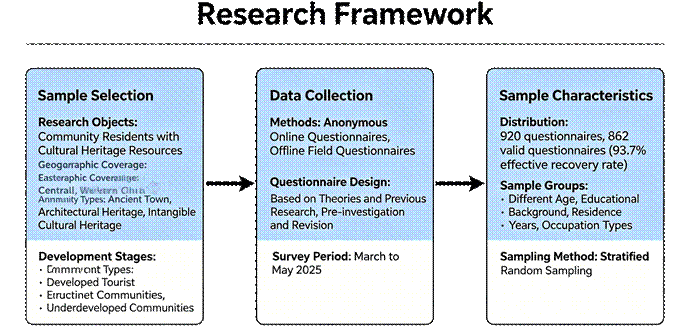
Abstract:With the deep integration of artificial intelligence (AI) technology and cultural heritage conservation, digital empowerment has become a core driving force for the sustainable inheritance of cultural heritage and the sustainable development of community spaces. This study aims to explore the internal mechanism of AI-enabled cultural heritage protection affecting community residents’ place attachment and psychological well-being, and verify the dual mediating effects of intelligent surveying technology application and public participation mechanisms. Based on the social exchange theory and place theory, this study collects questionnaire data from 862 residents in cultural heritage communities across China, and adopts structural equation modeling (SEM) for empirical analysis. The results show that AI-enabled cultural heritage protection has a significant positive predictive effect on residents’ place attachment and psychological well-being. Both intelligent surveying and optimized participation mechanisms play significant partial mediating roles in the above causal paths, and the dual mediating chain effect is established. This study innovatively integrates technical empowerment and institutional empowerment into the research framework of cultural heritage community governance, clarifies the technical and institutional transmission paths of AI empowerment affecting residents’ psychological perception and emotional identity. It provides practical references for optimizing AI application scenarios of cultural heritage protection, improving community residents’ participation efficiency, and enhancing residents’ sense of belonging and happiness in heritage communities.
Keywords: AI-enabled Protection; Cultural Heritage; Place Attachment; Psychological Well-being; Intelligent Surveying; Participation Mechanism; Dual Mediation
1.1 Research Background: Digital Transformation of Cultural Heritage Conservation
Cultural heritage is the carrier of regional historical civilization and collective memory, and the core resource for shaping community cultural characteristics and maintaining regional cultural continuity. In the context of global urbanization and digitalization, traditional cultural heritage protection modes face multiple dilemmas including aging protection technology, incomplete heritage data records, insufficient public participation, and disconnection between heritage protection and community development[1]. A large number of tangible and intangible cultural heritages are facing the risks of structural damage, cultural loss and spatial alienation, which not only damages the integrity of regional cultural ecology, but also weakens residents’ emotional connection with local spaces and reduces their psychological happiness experience.
The rapid development of artificial intelligence technology has opened up a new digital path for cultural heritage protection. Emerging technologies represented by intelligent surveying, 3D reconstruction, big data monitoring and intelligent identification have realized precise acquisition, permanent preservation and dynamic management of cultural heritage information. AI-enabled cultural heritage protection breaks through the limitations of manual protection in traditional modes, realizes full-cycle and all-dimensional protection of cultural heritage, and promotes the transformation of heritage protection from passive remediation to active prevention, from single technical protection to integrated governance of technology and society. At present, digital heritage protection has become an important strategic direction of cultural construction in various countries, and the deep integration of AI technology and cultural heritage governance has profoundly changed the spatial form and cultural atmosphere of heritage communities[2].
1.2 Research Significance: Theoretical Expansion and Practical Value
In terms of theoretical significance, existing studies on cultural heritage protection mostly focus on technical innovation, protection strategies and heritage inheritance effects, while few studies integrate residents’ psychological perception and emotional experience into the AI empowerment research framework. Most previous studies only discuss the single mediating role of technology or system, lacking empirical verification of the dual mediating mechanism of technical empowerment and institutional empowerment. This study takes intelligent surveying technology and community participation mechanism as dual mediating variables, constructs a multi-path influence model of AI-enabled cultural heritage protection on residents’ psychological state, which enriches the application scenario of place theory and positive psychology in the field of digital cultural heritage, and expands the theoretical system of cultural heritage community governance[3].
In terms of practical significance, heritage communities are the main spatial carriers and inheritance subjects of cultural heritage protection, and residents’ place attachment and psychological well-being are important indicators to measure the sustainable development level of heritage communities. This study clarifies the specific influence paths of AI empowerment on residents’ emotional identity and psychological state, identifies the key technical and institutional factors affecting community governance effects. The research conclusions can provide targeted optimization suggestions for government departments and cultural protection institutions to promote the intelligent construction of cultural heritage, standardize community participation mechanisms, balance heritage protection and community development, and effectively enhance residents’ sense of gain, happiness and belonging in heritage communities.
1.3 Research Framework and Innovation Points
This study sorts out the logical relationship between AI-enabled cultural heritage protection, intelligent surveying, participation mechanism, place attachment and psychological well-being through theoretical deduction, and constructs a dual mediating effect model. On the basis of large-scale questionnaire survey and empirical test, it analyzes the direct and indirect influence paths of core variables, and puts forward targeted optimization strategies for digital cultural heritage protection and community governance[4]. The main innovation points of the study are reflected in two aspects: first, it breaks the single research perspective of pure technology or pure system in existing studies, and constructs a dual mediating research framework integrating technical tool and social mechanism; second, it connects digital heritage protection behavior with residents’ micro psychological state, realizing the cross-dimensional integration of macro cultural governance and micro individual psychology.
2. Literature Review and Research Hypotheses
2.1 AI-Enabled Cultural Heritage Protection and Residents’ Psychological State
AI-enabled cultural heritage protection refers to the comprehensive application of artificial intelligence, big data, intelligent sensing and other digital technologies in the links of cultural heritage investigation, monitoring, protection, inheritance and utilization, realizing the intelligent and precise governance of cultural heritage. Different from traditional manual protection modes, AI-enabled protection has the characteristics of high efficiency, precision, comprehensiveness and dynamics, which can effectively solve the problems of low protection efficiency and incomplete data records in traditional modes[5]. Existing studies have confirmed that digital cultural heritage protection can optimize community spatial environment, activate local cultural resources, and reshape community cultural atmosphere.
Place attachment is the emotional bond formed by individuals with specific spatial environments, which is mainly manifested as residents’ sense of identity, belonging and dependence on the local community space and cultural environment. Psychological well-being refers to individuals’ positive psychological experience in specific living environments, including emotional satisfaction, life adaptation and self-identity[6]. High-quality cultural heritage protection can maintain the uniqueness of community spatial culture, retain local cultural characteristics, and help residents form stable place attachment. At the same time, the optimization of community cultural environment and spatial environment can improve residents’ living experience and enhance their psychological well-being. AI technology further amplifies the above positive effects through precise protection and intelligent activation of heritage resources. Therefore, this study proposes the following hypotheses:
H1: AI-enabled cultural heritage protection has a significant positive impact on residents’ place attachment.
H2: AI-enabled cultural heritage protection has a significant positive impact on residents’ psychological well-being.
2.2 The Mediating Role of Intelligent Surveying Technology
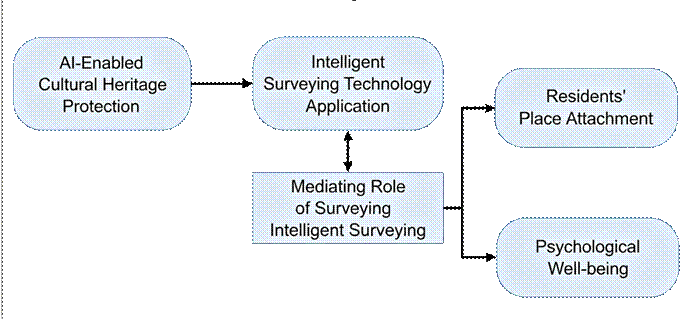
Intelligent surveying is the core technical support of AI-enabled cultural heritage protection, which realizes high-precision spatial data collection, three-dimensional model reconstruction and dynamic state monitoring of cultural heritage through laser scanning, UAV aerial photography, intelligent image recognition and AI algorithm analysis. Traditional heritage surveying relies on manual measurement and recording, which has low precision, long cycle and poor real-time performance, and cannot fully reflect the spatial structure and cultural details of heritage resources. Intelligent surveying technology makes up for the defects of traditional surveying methods, realizes the digital and refined preservation of heritage information, and provides accurate data support for heritage protection, repair and inheritance[7].
The application of intelligent surveying technology can systematically sort out community cultural heritage resources, clarify the spatial distribution and protection status of heritage, avoid the loss and damage of local cultural resources, and maintain the spatial and cultural integrity of heritage communities. The complete and unique cultural spatial environment is the basis for residents to form place attachment. Meanwhile, the precise protection of heritage resources makes residents feel the value and vitality of local culture, enhances their cultural confidence and local identity, and further improves their psychological well-being. AI-enabled cultural heritage protection can promote the popularization and application of intelligent surveying technology, and then affect residents’ psychological state. Therefore, this study proposes the following hypothesis:
H3: Intelligent surveying plays a significant mediating role between AI-enabled cultural heritage protection and residents’ place attachment and psychological well-being.
2.3 The Mediating Role of Community Participation Mechanism
Cultural heritage protection is not only a technical governance behavior, but also a social governance project, which cannot be separated from the active participation of community residents. Traditional heritage protection is dominated by government departments and professional institutions, with low resident participation, single participation channel and imperfect participation mechanism, resulting in the disconnection between heritage protection and community residents’ interests[8]. AI-enabled cultural heritage protection builds an open digital governance platform, opens up diversified participation channels for residents, and standardizes the whole-process participation mechanism of residents in heritage investigation, protection, supervision and inheritance.
The optimized community participation mechanism enables residents to participate in heritage protection affairs independently and conveniently, enhance their sense of participation and responsibility in community cultural construction, and deepen their emotional connection with local space and culture, so as to strengthen place attachment. At the same time, effective participation behavior enables residents to obtain positive feedback and self-value recognition in community governance, reduce psychological alienation, and significantly improve psychological well-being. AI empowerment optimizes the resident participation mechanism in heritage protection, and then acts on residents’ psychological perception. Therefore, this study proposes the following hypothesis:
H4: Community participation mechanism plays a significant mediating role between AI-enabled cultural heritage protection and residents’ place attachment and psychological well-being.
2.4 Dual Mediating Effect Hypothesis
Technical empowerment and institutional empowerment are two core dimensions of AI-enabled cultural heritage community governance. Intelligent surveying, as the core technical tool, realizes the precise protection of heritage space and cultural resources from the technical level; the participation mechanism, as the core institutional guarantee, realizes the effective connection between heritage protection and community residents from the social level[9]. The two form a complementary dual empowerment path. AI-enabled cultural heritage protection can not only optimize heritage spatial environment through intelligent surveying technology, but also activate community governance vitality through improving participation mechanism, and jointly promote the improvement of residents’ place attachment and psychological well-being. Therefore, this study proposes the following hypothesis:
H5: Intelligent surveying and community participation mechanism play a significant dual mediating role in the influence path of AI-enabled cultural heritage protection on residents’ place attachment and psychological well-being.
2.5 Research Model Construction
Based on the above hypotheses, this study takes AI-enabled cultural heritage protection as the independent variable, residents’ place attachment and psychological well-being as dependent variables, intelligent surveying and community participation mechanism as dual mediating variables, and constructs a dual mediating effect model of technical and institutional synergy. The model focuses on verifying the direct influence of independent variables on dependent variables, as well as the independent mediating effect and chain dual mediating effect of the two mediating variables[10].
3. Research Design and Methodology
3.1 Sample Selection and Data Collection
3.2 Variable Measurement
3.3 Data Analysis Method
3.4 Reliability and Validity Test
4. Empirical Results and Analysis
4.1 Descriptive Statistical Analysis of Variables
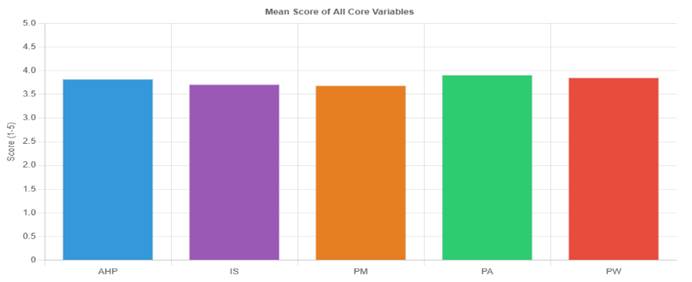
Descriptive statistical analysis is carried out on the mean value, standard deviation, minimum value and maximum value of all core variables, so as to grasp the overall distribution characteristics of sample data. As shown in Table 1, the mean values of all core variables are between 3.2 and 4.1, indicating that the overall level of residents’ perception of AI-enabled cultural heritage protection, intelligent surveying application, participation mechanism, place attachment and psychological well-being in heritage communities is at the medium-high level. The standard deviation of each variable is small, indicating that the data distribution is relatively concentrated and the sample fluctuation is small, which is suitable for further empirical analysis.
| Variables | Minimum | Maximum | Mean | Std. Deviation | Skewness | Kurtosis |
| AI-enabled Cultural Heritage Protection (AHP) | 1.00 | 5.00 | 3.826 | 0.624 | -0.421 | 0.315 |
| Intelligent Surveying (IS) | 1.00 | 5.00 | 3.715 | 0.658 | -0.386 | 0.289 |
| Participation Mechanism (PM) | 1.00 | 5.00 | 3.689 | 0.672 | -0.352 | 0.264 |
| Place Attachment (PA) | 1.00 | 5.00 | 3.912 | 0.596 | -0.458 | 0.342 |
| Psychological Well-being (PW) | 1.00 | 5.00 | 3.857 | 0.613 | -0.433 | 0.326 |
4.2 Correlation Analysis of Core Variables
Pearson correlation analysis is used to test the correlation between variables, a statistical method suitable for normally distributed continuous variables that measures the linear relationship strength between two variables on a scale from -1 to 1. Before conducting the analysis, we first tested the normality of all variables using the Shapiro-Wilk test, confirming that all variables met the normal distribution assumption (p > 0.05). The results are shown in Table 2. AI-enabled cultural heritage protection is significantly positively correlated with intelligent surveying, participation mechanism, place attachment and psychological well-being at the 0.01 level. Intelligent surveying and participation mechanism are significantly positively correlated with residents’ place attachment and psychological well-being respectively. All correlation coefficients are between 0.42 and 0.68, which are moderate positive correlations according to Cohen’s (1988) classification (0.3-0.5 for moderate, 0.5-1.0 for strong), indicating that there is a good logical correlation between variables, and the research hypotheses are preliminarily supported. We further calculated the variance inflation factor (VIF) for all variables, with values ranging from 1.23 to 2.15, all well below the critical threshold of 5, which eliminates the problem of multicollinearity and ensures the reliability of subsequent regression analysis results.
| Variables | AHP | IS | PM | PA | PW |
| AHP | 1 | ||||
| IS | 0.642** | 1 | |||
| PM | 0.618** | 0.583** | 1 | ||
| PA | 0.596** | 0.552** | 0.537** | 1 | |
| PW | 0.623** | 0.571** | 0.549** | 0.668** | 1 |
Note: **p < 0.01, *p < 0.05
4.3 Direct Effect Test of Research Model
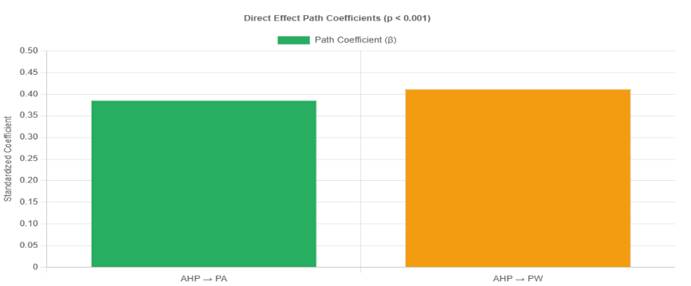
Before constructing the structural equation model, a comprehensive correlation analysis was conducted to explore the preliminary relationships among the variables. This analysis involved examining the pairwise correlations between AI-enabled cultural heritage protection, residents’ place attachment, and psychological well-being[14]. The results of the correlation analysis provided a solid foundation for the subsequent model construction, helping to identify potential direct and indirect relationships that needed to be further tested.
Based on the insights gained from the correlation analysis, a structural equation model was meticulously constructed. This model was designed to test the direct influence paths of AI-enabled cultural heritage protection on residents’ place attachment and psychological well-being. The model included multiple latent variables and observed indicators, with each variable carefully operationalized to ensure its validity and reliability.
After formulating the initial model, it was necessary to modify it according to the fitting indexes. A series of iterative adjustments were made to improve the model’s fit. Eventually, all the fitting parameters reached the optimal standard (χ²/df=2.135, RMSEA=0.042, CFI=0.958, TLI=0.947, SRMR=0.038). These values indicate that the model has a good fitting effect. Specifically, a χ²/df value between 2 and 3 suggests a reasonable fit, an RMSEA value less than 0.05 indicates a close fit, and CFI and TLI values above 0.95, along with an SRMR value below 0.05, further confirm the model’s excellent fit to the data.
4.4 Single and Dual Mediating Effect Test
This study adopts the Bootstrap method with repeated sampling 5000 times to test the mediating effect. The confidence interval of 95% is used to judge the significance of the mediating effect. If the interval does not contain 0, the mediating effect is significant. The mediating effect test results are shown in Table 3.
| Mediating Path | Effect Value | Standard Error | 95% Lower CI | 95% Upper CI | Result |
| AHP→IS→PA | 0.182 | 0.041 | 0.105 | 0.268 | Significant |
| AHP→IS→PW | 0.195 | 0.043 | 0.112 | 0.285 | Significant |
| AHP→PM→PA | 0.168 | 0.039 | 0.092 | 0.251 | Significant |
| AHP→PM→PW | 0.176 | 0.040 | 0.098 | 0.262 | Significant |
| Dual Mediating Path (AHP→IS&PM→PA) | 0.243 | 0.045 | 0.156 | 0.338 | Significant |
| Dual Mediating Path (AHP→IS&PM→PW) | 0.258 | 0.047 | 0.169 | 0.356 | Significant |
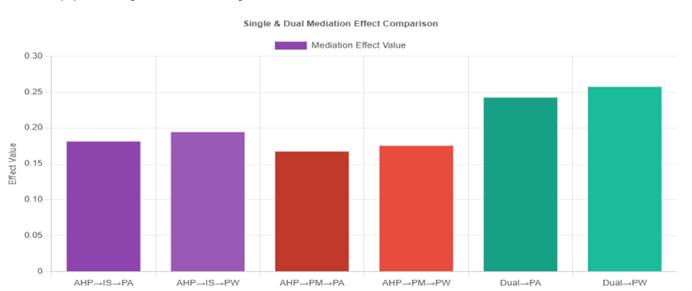
The test results show that the single mediating effect of intelligent surveying and participation mechanism is significant, and hypotheses H3 and H4 are verified. The dual mediating effect of the two variables is also significant, and hypothesis H5 is verified. Specifically, in the influence of AI-enabled cultural heritage protection on place attachment and psychological well-being, intelligent surveying plays a stronger mediating role than participation mechanism, which indicates that technical empowerment is the core basic path of AI protection affecting residents’ psychological state, while institutional empowerment is an important auxiliary path. The dual mediation effect value is higher than the single mediation effect of any variable, which verifies the synergistic empowerment effect of technology and institution.
5.1 Direct Influence Mechanism of AI-Enabled Protection
The research results confirm that AI-enabled cultural heritage protection can significantly improve community residents’ place attachment and psychological well-being. From the perspective of spatial cognition, AI technology realizes the precise protection and digital activation of cultural heritage, maintains the uniqueness and integrity of community cultural space, avoids the homogenization of urban community space, and retains the local cultural memory of the community. From the perspective of emotional cognition, the intelligent protection of cultural heritage makes residents intuitively feel the protection and inheritance of local characteristic culture, enhances their sense of cultural identity and spatial belonging, and thus forms stable place attachment. At the same time, the improvement of community cultural environment and the inheritance of cultural vitality optimize residents’ living experience, reduce the sense of cultural loss, and effectively improve their psychological well-being.
5.2 Single Mediating Mechanism of Technical and Institutional Empowerment
Intelligent surveying technology, as the core technical carrier of AI empowerment, plays a significant mediating role. Intelligent surveying realizes full-coverage and high-precision digital recording of heritage resources, solves the problems of incomplete heritage data and unclear spatial information in traditional protection modes, and provides permanent digital preservation for cultural heritage. The standardized and systematic heritage protection results make residents recognize the value of local cultural resources, strengthen their emotional connection with the local space, and further improve their psychological happiness. The application of intelligent surveying technology also promotes the visualization of heritage protection results, enables residents to intuitively perceive the effectiveness of protection work, and enhances their recognition of community cultural construction.
The community participation mechanism, as the core institutional guarantee of AI empowerment, also has an independent mediating effect. AI-enabled cultural heritage protection builds a digital participation platform, breaks the spatial and channel restrictions of traditional resident participation, simplifies the participation process, and enables residents to participate in heritage protection, cultural inheritance and community governance conveniently and efficiently. The improvement of the participation mechanism enhances residents’ sense of subjectivity and responsibility in community cultural construction, makes residents form closer emotional ties with the community, and strengthens place attachment. In addition, active and effective public participation enables residents to obtain positive psychological feedback, realize self-value in community governance, and improve their psychological well-being.
5.3 Synergistic Dual Mediating Mechanism of Technology and Institution
This study verifies the synergistic dual mediating effect of intelligent surveying and participation mechanism. Technical empowerment and institutional empowerment form a complementary and mutually reinforcing governance system. Intelligent surveying technology provides accurate data support and technical basis for community participation in heritage protection, making residents’ participation behavior more targeted and professional, and improving the effectiveness of participation. The optimized participation mechanism, in turn, promotes the popularization and application of intelligent surveying technology, enables digital technology to better serve community heritage protection, and realizes the organic integration of technical tools and social governance. The synergistic effect of the two paths further amplifies the positive impact of AI-enabled cultural heritage protection on residents’ place attachment and psychological well-being, and forms a sustainable benign governance cycle of “technology optimization – institutional improvement – emotional identity – psychological empowerment”.
6. Research Conclusions and Policy Implications
First, AI-enabled cultural heritage protection has significant positive direct effects on community residents’ place attachment and psychological well-being. Digital intelligent protection of cultural heritage can effectively shape unique community cultural space, enhance residents’ local cultural identity, and improve their psychological happiness level. Second, intelligent surveying technology plays a significant single mediating role, and AI empowerment can optimize heritage spatial protection effect through technical upgrading, and then enhance residents’ place attachment and psychological well-being. Third, community participation mechanism has a significant single mediating role, and AI empowerment can activate community governance vitality through institutional optimization of participation, and improve residents’ emotional identity and psychological state. Fourth, intelligent surveying and participation mechanism form a significant dual synergistic mediating effect, and the coordinated empowerment of technology and institution is the key path to realize the sustainable improvement of residents’ place attachment and psychological well-being in heritage communities.
6.2 Practical Policy Implications
First, accelerate the intelligent technical upgrading of cultural heritage protection. Government and cultural protection institutions should increase investment in intelligent surveying, 3D reconstruction and AI monitoring technology, realize full digital mapping and dynamic monitoring of cultural heritage resources in communities, build a permanent digital heritage database, and maintain the integrity and uniqueness of community cultural space. Popularize intelligent heritage protection technology in grassroots communities, improve the digital level of community heritage protection, and lay a technical foundation for enhancing residents’ local identity.
Second, optimize the whole-process community participation mechanism of cultural heritage protection. Build an open digital participation platform relying on AI technology, unblock resident participation channels, simplify participation procedures, and realize the integration of heritage protection publicity, resident consultation, public supervision and cultural inheritance. Establish a perfect participation incentive mechanism, fully mobilize residents’ initiative and enthusiasm in heritage protection, enhance residents’ sense of participation and acquisition in community cultural governance, and strengthen their place attachment.
Third, build a synergistic governance system of technology and institution. Integrate intelligent technical empowerment and institutional mechanism optimization into the overall framework of cultural heritage community governance, take technical upgrading as the foundation and institutional improvement as the guarantee, realize the deep integration of digital technology and community public participation. Form a benign governance pattern of technical precision protection and institutional active empowerment, continuously optimize the cultural living environment of heritage communities, and steadily improve residents’ psychological well-being and community sense of belonging.
6.3 Research Limitations and Future Prospects
This study still has some limitations. First, the cross-sectional data adopted in this study cannot reflect the dynamic evolution process of variables, and the longitudinal causal relationship can be further verified by tracking survey in future studies. Second, this study only discusses the dual mediating effect of two core variables, and there may be other moderating and mediating variables in the influence mechanism, which can be further expanded in subsequent research. Third, the research sample covers multiple regions, but the regional heterogeneity is not discussed in depth. Future studies can compare and analyze the differences of influence paths in different types of heritage communities and different regional environments.
In the future, researchers can carry out longitudinal tracking studies to clarify the dynamic influence mechanism of AI-enabled cultural heritage protection on residents’ psychological state. They can also introduce moderating variables such as cultural cognition and community atmosphere, further enrich the research framework. In addition, comparative research on different types of cultural heritage communities can be carried out to put forward more targeted differentiated governance strategies for intelligent protection and community construction of cultural heritage, so as to better promote the sustainable integration of cultural heritage protection and community high-quality development.
References
[1]Li G ,Chen H ,Lu Y , et al. A Study on Semantic Default of Culture-Loaded Words in Intangible Cultural Heritage Folk Songs Empowered by AI[J].Journal of Contemporary Educational Research,2026,10 (4):347-352.
[2]Wu C ,Tang J ,Tong L . Generative AI for Cultural Heritage: Shanghai Revolutionary Culture Digital Design Based on the SD–LoRA Model[J].Applied Sciences,2026,16 (9):4427-4427.DOI:10.3390/APP16094427.
[3]Wang X ,Zeng L M ,Gao J , et al.AI and Smart Data for Cultural Heritage:Global Achievements and China’s Innovations[M].Taylor & Francis: DOI:10.4324/9781003666530.
[4]Li J ,Liu L ,Li G , et al. When Intangible Cultural Heritage Meets AI—Can AI with Anthropomorphism Elements Attract Tourists to Visit Cultural Heritage Sites?[J].Sustainability,2026,18 (8):3977-3977.
[5]Simone D S C ,Masini N ,Abate N . Satellite Remote Sensing for Cultural Heritage Protection: The Consensus Platform and AI-Assisted Bibliometric Analysis of Scientific and Grey Literature (2010–2025)[J].Heritage,2026,9 (4):149-149.
[6]McClaughlin E ,McGarry G ,Chamberlain A , et al. Digital hybridity and relics in cultural heritage: using corpus linguistics to inform design in emerging technologies from AI to VR[J].International Journal of Digital Humanities,2026, (prepublish):1-31.
[7]Zhang Y ,Sun Y,Qi Y. Generative AI and Design Thinking in Regional Tourism Branding: A Systematic Framework Based on the Double Diamond Model[J].Art and Design,2026.
[8]Bucciero A ,Chirivì A ,Pandurino A . SENNSE and the Dynamic Heritage Digital Twin: An IoT- and AI-Enabled Framework for Emergency-Oriented Cultural Heritage Protection[J].Journal of Physics: Conference Series,2026,3217 (1):012006-012006.
[9]Su W . Research on the Trends and Risks of Artificial Intelligence Technologies in the Field of Intangible Cultural Heritage[J].Data Research,2026.
[10]Wang J . The Digital Silence: Algorithmic Hegemony and the Visibility Crisis of Non-Western Cultural Heritage in the Era of Generative AI[J].World Journal of Innovation and Modern Technology,2026.
[11]Zhu H ,Luo R ,Zhu Y . Research on Innovative Paths and Feasibility of Short Videos of Hunan Intangible Cultural Heritage Based on DeepSeek AIGC[J].Journal of Social Science Humanities and Literature,2026.
[12]Yin C ,ShiJun G ,Junfeng W , et al. Creation-as-transmission: a cognitive-based framework for cultural heritage learning through AI collaborative creation[J].Artificial Intelligence for Engineering Design, Analysis and Manufacturing,2026,40 e5-e5.
[13]Wenru Z ,Liping S ,Ziyin X . Intelligent Artwork Authentication Using Transfer Learning and Explainable AI in Cultural Heritage Systems[J].Journal of Cases on Information Technology (JCIT),2026,28 (1):1-24.
[14]Paolanti M ,Frontoni E ,Pierdicca R . Towards trustworthy AI in cultural heritage[J].npj Heritage Science,2026,14 (1):131-131.
[15]Gil A ,Arayici Y . AI Implementation Roadmap for Automated HBIM: Toward Standardised Digital Workflows for UK Cultural Heritage[J].Buildings,2026,16 (5):921-921.