Yunbi Chi*
Longyan University , Longyan, 364012, China
aEmail: chai_ybi@163.com
Abstract:With the comprehensive penetration of digital technology in the field of higher education, artificial intelligence (AI) has become a core driving force for the reform and innovation of college education and teaching. AI empowers higher education by reconstructing teaching modes, optimizing learning resources, and enriching campus service scenarios, which profoundly changes the learning and living environment of college students. Mental health is a key component of college students’ comprehensive development, and psychological adaptation serves as a critical bridge connecting external environmental changes and individual mental state adjustment. This study takes college students as the research object, explores the direct impact of AI-enabled higher education on college students’ mental health, and verifies the mediating effect of psychological adaptation between the two variables. Based on a literature review and empirical analysis, this study clarifies the internal mechanism of AI education reform acting on college students’ mental health development. The research finds that moderate AI empowerment in higher education can positively optimize college students’ mental health status, while excessive technical dependence may induce potential mental risks. Psychological adaptation plays a partial mediating role, AI empowerment can promote students’ mental health level by improving their academic adaptation, social adaptation and environmental adaptation. This study provides theoretical support for the intelligent construction of higher education and the optimization of college mental health education system, and offers practical references for guiding college students to adapt to intelligent educational environments and maintain positive mental states.
Keywords: Artificial Intelligence; Higher Education Empowerment; College Students; Mental Health; Psychological Adaptation; Mediating Effect
1.1 Research Background: Intelligent Education Reform and Youth Mental Development
In the era of digital intelligence, artificial intelligence technology represented by big data, machine learning and intelligent algorithms has realized in-depth integration with the field of higher education. The traditional teacher-centered, fixed-mode college education model is gradually transforming into a student-centered, personalized and intelligent education new model. AI technology empowers every link of higher education including classroom teaching, resource allocation, academic management and campus services, forming a full-scene intelligent education ecosystem. Intelligent teaching platforms, personalized learning systems, intelligent assessment tools and digital campus services have become indispensable parts of contemporary college students’ learning and life, fundamentally changing students’ learning methods, cognitive modes and social interaction paths[1].
College stage is a critical period for individual psychological maturity and personality improvement, during which students are in a stage of sensitive psychological development and vulnerable to external environmental changes. In the context of intelligent education reform, while enjoying the convenient learning conditions brought by AI technology, college students also face new psychological challenges[2]. The substitution of intelligent technology for manual teaching, the fragmentation of digital learning information, the competition of intelligent learning efficiency and the changes of campus social scenarios all bring dual effects on college students’ mental health. In recent years, the mental health problems such as learning anxiety, social avoidance and adaptive disorder among college students have shown a rising trend, which is closely related to the comprehensive popularization of intelligent educational environments. Therefore, it is urgent to explore the correlation mechanism between AI empowering higher education and college students’ mental health[3].
Psychological adaptation, as an individual’s active adjustment behavior and state to adapt to environmental changes, is an important intermediate variable explaining the impact of external environmental changes on individual mental health. In the intelligent educational environment, college students need to constantly adjust their learning habits, cognitive methods and social modes to adapt to AI-enabled teaching and campus management[4]. Good psychological adaptation can help students digest the positive value of intelligent education and avoid negative psychological impacts, while poor adaptation will trigger a series of mental health problems. Based on this, exploring the mediating role of psychological adaptation can effectively reveal the internal logical path of AI education affecting college students’ mental health, and make up for the research gap of single correlation analysis in existing studies.
1.2 Research Significance: Theoretical Innovation and Practical Value
Theoretical Significance: Existing studies on AI empowering higher education mostly focus on teaching effect optimization, education mode innovation and talent training quality improvement, while few studies take college students’ mental health as the research perspective, and lack of in-depth discussion on the psychological mechanism of intelligent education reform. This study constructs a mediating effect model with psychological adaptation as the core, clarifies the causal relationship and action path between AI-enabled higher education and college students’ mental health, enriches the research system of educational psychology in the digital intelligence era, expands the application scope of psychological adaptation theory, and provides a new theoretical perspective for subsequent related research on intelligent education and youth mental health[5].
Practical Significance: This study systematically analyzes the positive and negative impacts of AI empowering higher education on college students’ mental health, identifies the key role of psychological adaptation in the influence process. The research conclusions can provide practical guidance for colleges and universities to optimize intelligent education construction, formulate targeted mental health education strategies, and build a benign interactive mechanism between intelligent education reform and students’ mental development. At the same time, it can guide college students to correctly treat intelligent educational tools, actively improve their psychological adaptation ability, and resist negative mental risks brought by technological changes, so as to realize the coordinated development of intelligent education innovation and students’ healthy growth[6].
1.3 Research Framework and Methods: Overall Ideas and Technical Paths
This study adopts a combination of literature research and empirical analysis. Firstly, it sorts out domestic and foreign literature on AI empowering higher education, college students’ mental health and psychological adaptation, defines the core connotation and dimensional division of each variable, and constructs a theoretical research model. Secondly, it designs a standardized questionnaire scale, conducts sample investigation on college students in different types of universities, and obtains valid research data. Then, it uses statistical analysis software to carry out descriptive statistical analysis, correlation analysis and mediating effect test on the data, so as to verify the research hypotheses[7]. Finally, it summarizes the research conclusions, puts forward targeted optimization strategies, and analyzes the research deficiencies and future research directions.
The overall research framework is divided into five core parts: literature review and theoretical foundation, research hypothesis and model construction, research design and data collection, empirical analysis and hypothesis test, research conclusion and prospect. Each part is closely linked and logically progressive, ensuring the scientificity and comprehensiveness of the research results.
2. Literature Review and Theoretical Foundation
2.1 Research on AI Empowering Higher Education: Connotation, Dimensions and Current Situation
AI empowering higher education refers to the process of taking artificial intelligence technology as the core support, reconstructing the educational teaching system, optimizing educational resource allocation, improving educational management efficiency, and realizing the intelligent upgrading of higher education. Different from the simple technical application in traditional education, AI empowerment emphasizes the deep integration of technology and educational essence, realizing personalized teaching, precise management and efficient service in higher education. Existing studies divide the dimensions of AI empowering higher education into three core levels: intelligent teaching empowerment, resource service empowerment and campus management empowerment.
Intelligent teaching empowerment is the core dimension of educational empowerment, including intelligent classroom teaching, personalized teaching guidance and intelligent teaching assessment. AI-based intelligent teaching systems can monitor students’ learning behavior in real time, analyze learning data, accurately grasp students’ learning progress and knowledge mastery, and formulate personalized teaching plans for students, which breaks through the limitations of unified teaching in traditional classrooms. Resource service empowerment takes intelligent digital resources as the carrier, integrates massive high-quality educational resources, breaks the time and space restrictions of traditional resource acquisition, and provides students with diversified, personalized and on-demand learning resource services[8]. Campus management empowerment realizes the intelligent management of student daily affairs, academic management and safety management through big data and intelligent algorithms, improving the refinement and efficiency of college campus operation.
Current foreign research on AI empowering higher education started earlier, focusing on the innovation of intelligent teaching models and the improvement of teaching efficiency. Foreign scholars have verified that AI personalized teaching systems can significantly improve students’ learning initiative and learning efficiency. Domestic research focuses more on the localized application of AI education technology, exploring the application path of intelligent education in Chinese colleges and universities and the optimization strategy of talent training mode. However, most existing studies focus on the educational teaching level, and lack of attention to the individual psychological development of students, which is the key breakthrough direction of this study.
2.2 Research on College Students’ Mental Health: Influencing Factors and Development Characteristics
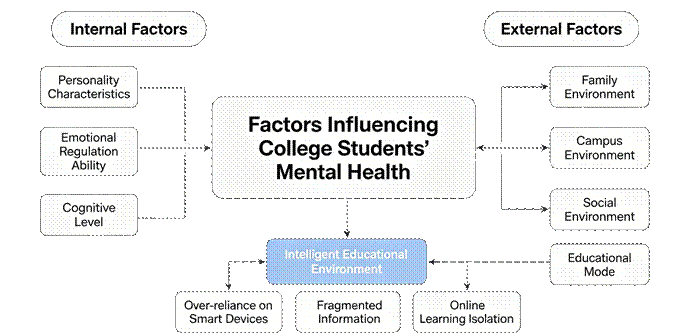
College students’ mental health refers to the individual’s good psychological state in the process of adapting to college study, life and social interaction, including positive emotional state, good interpersonal adaptation, stable psychological quality and positive life attitude. It is an important index to measure the comprehensive development level of college students. The mental health development of college students has obvious stage characteristics. College students are in the transition period from adolescence to adulthood, with immature psychological development, fragile emotional regulation ability and strong environmental sensitivity, which makes them vulnerable to external environmental changes and produce emotional fluctuations and psychological pressure.
Existing studies have shown that the influencing factors of college students’ mental health include individual internal factors and external environmental factors. Internal factors cover individual personality characteristics, emotional regulation ability and cognitive level, while external factors include family environment, campus environment, social environment and educational mode. In the digital intelligence era, the intelligent educational environment has become a new important external factor affecting college students’ mental health. The popularization of intelligent teaching equipment and digital learning modes changes students’ learning rhythm and social interaction mode, bringing new opportunities and challenges to students’ mental health development.
In recent years, with the continuous promotion of intelligent education in colleges and universities, the psychological problems caused by intelligent learning environments have gradually attracted academic attention. Excessive dependence on intelligent equipment leads to the decline of students’ autonomous learning ability, fragmented information acquisition leads to cognitive confusion, and online learning isolation leads to social anxiety, which all restrict the healthy development of college students’ psychology. However, most existing studies are descriptive analysis, lacking empirical research on the mechanism of action, and the research depth needs to be further improved[9].
Psychological adaptation is a positive psychological adjustment process in which individuals actively change their cognitive modes, behavioral habits and emotional states to adapt to external environmental changes and maintain psychological balance. It is the core psychological quality for individuals to cope with environmental changes. For college students, psychological adaptation in the intelligent education environment mainly includes three dimensions: academic psychological adaptation, social psychological adaptation and environmental psychological adaptation.
Academic psychological adaptation refers to students’ adaptive adjustment to the intelligent learning mode, including the adaptation of online and offline mixed teaching, the use of intelligent learning tools, and the adjustment of autonomous learning rhythm. Social psychological adaptation refers to the adaptive changes of students’ interpersonal interaction mode under the intelligent campus environment, including online social communication, group cooperative learning under intelligent scenarios, and the balance of virtual and real social interaction. Environmental psychological adaptation refers to students’ psychological acceptance and adaptive adjustment to the intelligent campus hardware environment, digital management mode and intelligent service system.
A large number of studies have confirmed that psychological adaptation has a significant mediating effect between external environmental factors and individual mental health. External environmental changes will not directly act on individual mental state, but affect mental health level through individual psychological adaptation adjustment. Good psychological adaptation can buffer the negative impact of environmental changes and transform environmental advantages into positive psychological resources, while poor psychological adaptation will amplify environmental pressure and induce mental health problems[10]. This theoretical conclusion provides an important theoretical basis for this study to construct the mediating effect model.
2.4 Research Review: Deficiencies and Breakthrough Points of Existing Studies
Through sorting out domestic and foreign relevant literature, it is found that existing studies have formed certain research achievements in AI empowering higher education, college students’ mental health and psychological adaptation, but there are still obvious deficiencies. First, the research perspective is single. Most studies focus on the impact of intelligent education on teaching quality, and few studies explore its impact on college students’ mental health, lacking humanistic care perspective in intelligent education research. Second, the research mechanism is superficial. Existing related studies mostly stay in simple correlation analysis, without exploring the internal transmission path of variables, and lack empirical test of mediating variables[11]. Third, the dimensional research is incomplete. Few studies divide the dimensional characteristics of AI education empowerment and college students’ psychological adaptation, and fail to reveal the differential impact of different empowerment dimensions on mental health.
Based on the above research deficiencies, this study takes psychological adaptation as the mediating variable, constructs a theoretical model of AI empowering higher education affecting college students’ mental health, divides variables into multiple dimensions for empirical analysis, reveals the internal mechanism of intelligent education affecting college students’ mental health, and makes up for the deficiencies of existing research.
3. Theoretical Model and Research Hypothesis
3.1 Theoretical Model Construction
Based on ecological system theory and psychological adaptation theory, this study constructs a mediating effect model with AI empowering higher education as the independent variable, college students’ psychological adaptation as the mediating variable, and college students’ mental health as the dependent variable. Among them, AI empowering higher education includes three dimensions: intelligent teaching empowerment, resource service empowerment and campus management empowerment; psychological adaptation includes three dimensions: academic adaptation, social adaptation and environmental adaptation; college students’ mental health is measured by positive emotional state, low anxiety level and good psychological resilience.
The theoretical model assumes that AI empowering higher education can not only directly affect college students’ mental health, but also indirectly affect mental health through the mediating effect of psychological adaptation. The direct effect is reflected in the dual positive and negative impacts of intelligent educational environment on students’ psychological state; the indirect effect is reflected in that AI empowerment optimizes students’ academic, social and environmental adaptation states, and then improves their overall mental health level.
3.2 Research Hypothesis Proposal
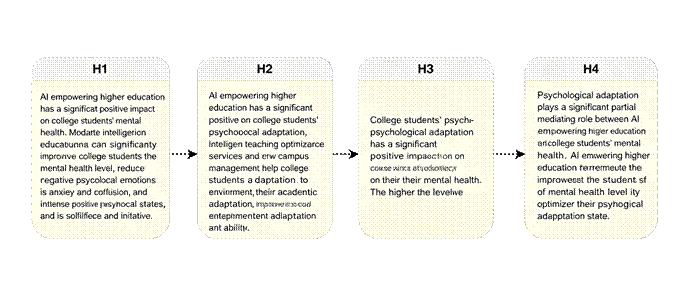
Hypothesis H1: AI empowering higher education has a significant positive impact on college students’ mental health. Moderate intelligent education empowerment can significantly improve college students’ mental health level, reduce negative psychological emotions such as anxiety and confusion, and enhance positive psychological states such as self-confidence and initiative.
Hypothesis H2: AI empowering higher education has a significant positive impact on college students’ psychological adaptation. Intelligent teaching optimization, rich resource services and efficient campus management can help college students adapt to the new educational environment, improve their academic adaptation, social adaptation and environmental adaptation ability.
Hypothesis H3: College students’ psychological adaptation has a significant positive impact on their mental health. The higher the level of academic, social and environmental adaptation, the better the college students’ mental health state, and the lower the probability of psychological problems.
Hypothesis H4: Psychological adaptation plays a significant partial mediating role between AI empowering higher education and college students’ mental health. AI empowering higher education can indirectly promote the improvement of college students’ mental health level by optimizing their psychological adaptation state.
4. Research Design and Data Collection
In this study, all variables are measured by mature standardized scales with good reliability and validity, and the Likert 5-point scoring method is adopted (1=completely inconsistent, 5=completely consistent). Independent variable: AI empowering higher education scale, including 18 items in three dimensions of intelligent teaching empowerment, resource service empowerment and campus management empowerment. Mediating variable: College students’ psychological adaptation scale, including 15 items in three dimensions of academic adaptation, social adaptation and environmental adaptation. Dependent variable: College students’ mental health scale, including 12 items, mainly measuring students’ emotional state, psychological pressure and psychological resilience.
4.2 Questionnaire Design and Distribution
The questionnaire of this study consists of four parts: basic demographic information, AI higher education empowerment measurement, psychological adaptation measurement, and mental health status measurement. The survey objects are undergraduate and postgraduate students from different types of colleges and universities in China, covering comprehensive universities, science and engineering universities, liberal arts universities and vocational colleges, to ensure the represent ativeness and universality of the sample[12]. The questionnaire is distributed through online platform and offline random sampling, and a total of 650 questionnaires are distributed, with 612 valid questionnaires recovered, and the effective recovery rate is 94.15%.
4.3 Reliability and Validity Test of Questionnaire
Reliability test is used to verify the internal consistency of the questionnaire data. The Cronbach’s α coefficient of the total questionnaire is 0.892, and the α coefficients of each variable dimension are all higher than 0.8, indicating that the questionnaire has good internal consistency and reliable data. Validity test adopts content validity and structural validity test. All scales are mature scales used in domestic and foreign authoritative studies, with good content validity. Confirmatory factor analysis is used to test structural validity, and the fitting indexes of the model are all within the standard range, indicating that the questionnaire has good structural validity and can be used for subsequent empirical analysis.
5. Empirical Analysis and Hypothesis Test
5.1 Descriptive Statistical Analysis of Variables
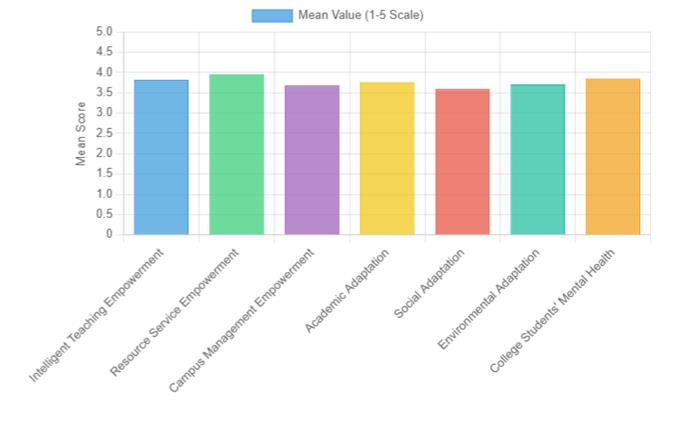
This study conducts descriptive statistical analysis on the mean value, standard deviation, maximum value and minimum value of each variable dimension, so as to grasp the overall level of college students’ perception of AI education empowerment, psychological adaptation and mental health status. The statistical results show that the overall mean value of each variable is between 3.2 and 4.1, indicating that most college students have a positive perception of AI empowering higher education, their psychological adaptation level is medium to upper, and their overall mental health status is good. The specific descriptive statistical results are shown in Table 1.
| Variable Dimension | Sample Size | Minimum Value | Maximum Value | Mean Value | Standard Deviation |
| Intelligent Teaching Empowerment | 612 | 1.00 | 5.00 | 3.82 | 0.625 |
| Resource Service Empowerment | 612 | 1.00 | 5.00 | 3.95 | 0.583 |
| Campus Management Empowerment | 612 | 1.00 | 5.00 | 3.68 | 0.651 |
| Academic Adaptation | 612 | 1.00 | 5.00 | 3.76 | 0.632 |
| Social Adaptation | 612 | 1.00 | 5.00 | 3.59 | 0.687 |
| Environmental Adaptation | 612 | 1.00 | 5.00 | 3.71 | 0.645 |
| College Students’ Mental Health | 612 | 1.00 | 5.00 | 3.85 | 0.618 |
5.2 Correlation Analysis of Variables
5.3 Direct Effect Test
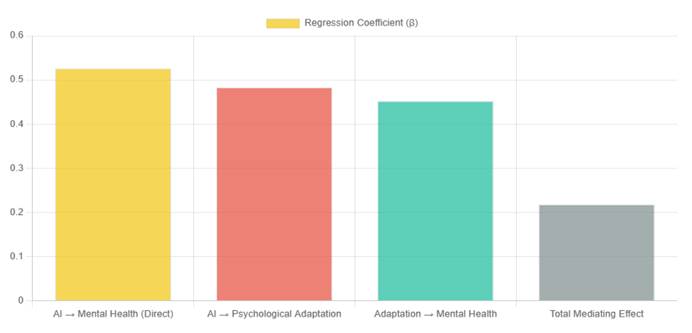
Using college students’ mental health as the dependent variable and AI empowering higher education as the independent variable, hierarchical regression analysis was conducted to examine the direct impact of AI education empowerment on mental health. The regression results demonstrate that the overall empowerment level of AI in higher education has a significant positive predictive effect on college students’ mental health (β=0.526, p<0.001). Among the specific dimensions, intelligent teaching empowerment and resource service empowerment show stronger positive predictive effects, whereas campus management empowerment exhibits a relatively weaker positive effect. This finding validates Hypothesis H1, indicating that AI empowering higher education can effectively enhance the mental health level of college students, thereby supporting the proposed theoretical model.
This study adopts the bootstrap mediating effect test method to verify the mediating role of psychological adaptation. The test results show that the total mediating effect value is 0.218, and the 95% confidence interval does not include 0, indicating that the mediating effect of psychological adaptation is significant. Specifically, AI empowering higher education can significantly positively predict psychological adaptation (β=0.483, p<0.001), and psychological adaptation can significantly positively predict college students’ mental health (β=0.452, p<0.001). After adding the mediating variable, the direct effect of AI empowerment on mental health is still significant, but the effect value decreases, which indicates that psychological adaptation plays a partial mediating role between the two variables. This result fully verifies Hypothesis H2, H3 and H4.
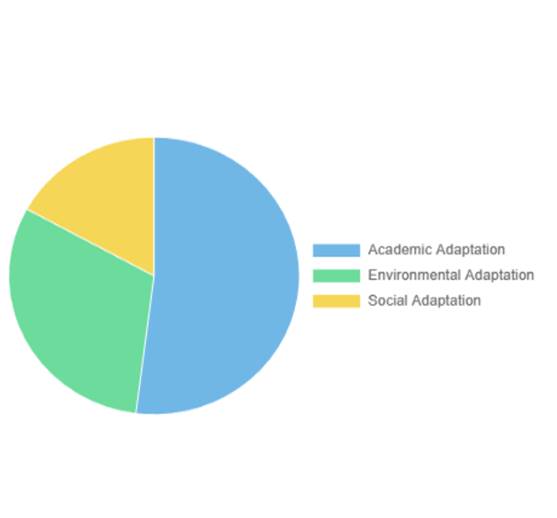
From the perspective of dimensional difference, academic adaptation has the strongest mediating effect, followed by environmental adaptation, and social adaptation has the weakest mediating effect. This shows that in the intelligent educational environment, the optimization of students’ academic adaptation state is the most important intermediate path for AI education to improve mental health.
6. Research Discussion and Mechanism Analysis
6.1 Direct Influence Mechanism of AI Education Empowerment on Mental Health
The empirical results confirm that AI empowering higher education has a significant positive direct impact on college students’ mental health. On the one hand, intelligent teaching empowerment optimizes the learning experience of college students. Personalized intelligent teaching breaks the one-size-fits-all teaching mode, can formulate targeted learning plans according to students’ learning differences, effectively reduce students’ learning pressure and learning frustration, and enhance students’ learning self-confidence and sense of achievement, so as to promote positive emotional generation[13]. On the other hand, intelligent resource service empowerment enriches students’ learning channels, meets students’ diversified learning needs, improves learning efficiency, and avoids negative emotions such as anxiety and confusion caused by insufficient learning resources and blocked learning channels.
At the same time, the study also finds that excessive dependence on intelligent technology will bring potential negative psychological impacts. Excessive use of intelligent learning tools will reduce students’ autonomous thinking ability and independent problem-solving ability, make students form technological dependence, and easily produce psychological gaps and anxiety when leaving intelligent equipment. In addition, the virtualization of intelligent campus services reduces offline interpersonal communication, which may induce mild social avoidance psychology for individual students.
6.2 Mediating Mechanism of Psychological Adaptation in Variable Relationship
Psychological adaptation plays a partial mediating role between AI empowering higher education and college students’ mental health, which reveals the internal transmission path of external environmental changes affecting individual mental state. First of all, AI education empowerment optimizes students’ academic adaptation state. Intelligent teaching platforms record learning data in real time, help students clarify learning deficiencies, adjust learning strategies, and form a scientific and efficient intelligent learning rhythm, so that students can quickly adapt to the new teaching mode and maintain a stable learning psychology[14].
Secondly, AI campus management and service empowerment improve students’ environmental adaptation level. Intelligent campus service simplifies daily affairs processing procedures, improves campus operation efficiency, reduces students’ trivial life pressure, and enables students to quickly adapt to the intelligent campus environment, forming a stable environmental psychological cognition. Finally, the intelligent cooperative learning mode promotes students’ social adaptation. Online intelligent group learning and interactive platforms expand students’ social channels, enrich students’ interpersonal interaction forms, and help students adapt to the diversified social modes in the digital era, reducing social anxiety and loneliness.
The dimensional difference of mediating effect shows that academic adaptation is the core mediating path. College students’ main task is academic learning, and the adaptation of intelligent learning mode directly determines their learning psychological state, and then affects the overall mental health level. Social adaptation has a weak mediating effect, which is related to the fact that some students are not proficient in using intelligent social tools and lack of in-depth offline communication, resulting in slow social adaptation progress.
6.3 Comprehensive Analysis of Positive and Negative Dual Effects
Combined with empirical results and theoretical analysis, AI empowering higher education has dual positive and negative effects on college students’ mental health, and the final effect depends on students’ psychological adaptation level and the degree of rational use of intelligent technology. For students with good psychological adaptation ability, they can actively use intelligent educational tools to optimize learning effects, enrich campus life, and transform technological advantages into positive psychological resources, so as to improve mental health level. For students with poor psychological adaptation ability, they are easy to be confused by fragmented information, rely excessively on intelligent technology, and fail to adapt to the changes of educational modes, resulting in learning anxiety, social isolation and other psychological problems[15].
Therefore, the intelligent construction of higher education cannot blindly pursue technological innovation and popularization, but needs to match students’ psychological adaptation ability, realize the benign interaction between technological empowerment and students’ psychological development, and avoid the negative psychological risks brought by technological alienation.
7. Research Conclusions and Countermeasure Suggestions
First, AI empowering higher education has a significant positive impact on college students’ mental health. Moderate intelligent teaching optimization, resource service upgrading and campus intelligent management can effectively improve college students’ positive emotional state, reduce psychological pressure, and promote the healthy development of students’ psychology.
Second, AI empowering higher education can significantly improve college students’ psychological adaptation level, effectively promote students’ academic adaptation to intelligent learning modes, environmental adaptation to intelligent campus scenarios, and social adaptation to digital interactive modes.
Third, college students’ psychological adaptation has a significant positive effect on mental health. The higher the level of academic, social and environmental adaptation, the better the students’ mental health status.
Fourth, psychological adaptation plays a partial mediating role between AI empowering higher education and college students’ mental health. AI education empowerment can not only directly affect mental health, but also indirectly optimize students’ mental state by improving their psychological adaptation ability, and the mediating effect of academic adaptation is the most prominent.
7.2 Optimized Countermeasure Suggestions
Optimize Intelligent Education Construction to Balance Technological Empowerment and Psychological Development. Colleges and universities should adhere to the people-oriented intelligent education construction concept, avoid excessive technological instrumentalization, and formulate hierarchical intelligent teaching schemes according to students’ adaptive differences. In the process of promoting AI education reform, appropriately retain traditional teaching links and offline interactive scenarios, reduce students’ excessive dependence on intelligent equipment, and balance the advantages of intelligent technology and the authenticity of educational interaction, so as to reduce potential psychological risks.
Build a Psychological Adaptability Training System to Improve Students’ Adaptive Quality. Colleges and universities should incorporate intelligent environment adaptation education into the mental health education system, set up special courses and training activities on intelligent learning adaptation, digital social adaptation and campus intelligent environment adaptation. Targetedly solve students’ adaptive problems such as intelligent learning confusion and digital social anxiety, improve students’ psychological adjustment ability in the intelligent educational environment, and give full play to the positive mediating value of psychological adaptation.
Improve the Intelligent Mental Health Service System to Realize Precise Psychological Guidance. Rely on AI big data technology, build a college students’ mental health dynamic monitoring system, accurately capture students’ learning behavior, emotional changes and adaptive state in the intelligent educational environment, timely identify potential psychological problems, and carry out personalized psychological counseling and intervention. Integrate intelligent technology and mental health education, innovate mental health service modes, and build a full-time and all-round mental health protection system.
Guide Rational Technological Cognition to Shape Positive Psychological Quality. Strengthen the publicity and guidance of intelligent technology cognition for college students, help students correctly understand the auxiliary positioning of AI technology in education and learning, establish rational technology use concepts, avoid technological dependence and technological alienation. Guide students to take the initiative to adapt to intelligent educational changes, cultivate independent learning ability and digital social ability, and form positive and stable psychological quality.
7.3 Research Deficiencies and Future Prospects
This study has certain theoretical and practical value, but there are still some deficiencies. First, the research sample is limited, and the survey scope is mainly domestic college students, which cannot fully cover the group characteristics of students in different educational environments, and the universality of the research conclusion needs to be further verified. Second, this study only discusses the single mediating effect of psychological adaptation, and does not involve the regulatory variables in the model, and the research mechanism can be further deepened. Third, this study adopts cross-sectional data for analysis, and cannot reflect the dynamic change relationship between variables in the long term.
In future research, the sample scope can be expanded, covering different regions and different levels of colleges and universities, and even international college student groups, to improve the universality of research conclusions. On the basis of this study, regulatory variables such as individual technological literacy and campus humanistic atmosphere can be added to build a more complex and complete theoretical model. Longitudinal tracking investigation can be carried out to explore the dynamic evolution mechanism of AI education empowerment affecting college students’ mental health, so as to provide more scientific and accurate theoretical support for the high-quality development of intelligent higher education and college students’ mental health education.
References
[1]Clossey L ,DiLauro D M ,Pazaki H S , et al. A qualitative study examining cultural perceptions of mental health among diverse University students and staff[J].Social Work in Mental Health,2026,24 (4):380-402.
[2]Dat T N ,Trung T T C ,Teh J C , et al. Mental health profiles in post COVID-19 Vietnam: a comparison of university students, non-traditional students, and working adults[J].Current Psychology,2026,45 (11):1039-1039.
[3]Pupi V ,Mangialavori S ,Fave D A . Correction to: Unveiling the Heterogeneity of Moderate Mental Health Among College Students Through Latent Profile Analysis: Implications for Intervention[J].Journal of Happiness Studies,2026,27 (5):77-77.
[4]A. C C ,Tia K ,Shaina J H , et al. Investigating minority status stress and mental health of racially minoritized college students: The importance of the university environment.[J].Journal of Diversity in Higher Education,2026,19 (3):391-400.
[5]Lynch J R ,Little A . The resilience myth: relationships among mental health wellbeing, campus connection, and resilience in Queer community college students[J].International Journal of LGBTQ+ Youth Studies,2026,23 (3):538-558.
[6]Paulus P M . Current themes of AI in mental health: Actionable evidence and guardrails for mood and anxiety care[J].Journal of Mood and Anxiety Disorders,2026,14 100181-100181.
[7]Araoz E G E . Artificial intelligence mediated emotional support in mental health and its ethical and governance implications in digital public health[J].Discover Public Health,2026,23 (1):819-819.
[8]Fan Z ,Sun P ,Li L . Healing the healers: understanding the rising mental health crisis among Chinese medical students.[J].Internal and emergency medicine,2026, (prepublish):1-2.
[9]Tony R ,Yimeng Z ,Xu L , et al. Large language models as mental health resources: Patterns of use in the United States.[J].Practice Innovations,2026,11 (2):139-155.
[10]Luo J ,Yang C . Innovation research on college students’ mental health management system based on internet of things technology.[J].Scientific reports,2026, DOI:10.1038/S41598-026-54082-2.
[11]Ward A J ,Kew M B ,Jordan J , et al. Medical student mental health and the role of rumination.[J].The New Zealand medical journal,2026,139 (1635):125-132.
[12]Liu H C ,Zhang W ,Lou F , et al. Clinical and sociodemographic predictors of AI use for mental health among college students.[J].Journal of affective disorders,2026, 122058.
[13]Lucassen L ,Rinaldi R ,Batselé E . Comparative study of medical and mental health students’ empathy and attitudes towards intellectual disability in Belgium.[J].Psychology, health & medicine,2026, 1-19.
[14]Liang L ,Lu X ,Jiao D , et al. Application and effectiveness of artificial intelligence in adolescent mental health support and therapy: a scoping review.[J].BMC psychiatry,2026,
[15]Lee H ,Handler R ,Mungle T , et al. Building safer artificial intelligence mental health chatbots: a framework for transparency, evaluation, and shared accountability.[J].Journal of the American Medical Informatics Association : JAMIA,2026.