Dr.Haris William
Belgium University
Abstract:Against the backdrop of global carbon peaking and carbon neutrality goals, carbon emission constraints have become a rigid institutional norm restricting the high-quality development of the manufacturing industry. Environmental regulation, as a core policy tool for carbon reduction and green transformation, exerts dual and differentiated influences on industrial technological progress and human resource psychology. Based on the panel data of China’s manufacturing industry from 2018 to 2024, this study adopts artificial intelligence (AI) empirical methods including machine learning regression and text mining to systematically explore the dual effects of heterogeneous environmental regulations on manufacturing technological innovation and employees’ occupational anxiety under carbon emission constraints, and further analyzes the threshold effect and regional heterogeneity of carbon constraints. The research results show that carbon emission constraints strengthen the incentive effect of formal environmental regulation on manufacturing technological innovation while amplifying the negative impact of regulatory pressure on employees’ occupational anxiety. Informal environmental regulation presents a weak innovation-promoting effect and a significant anxiety-alleviating effect. AI-based threshold model estimation confirms that when carbon emission constraint intensity exceeds the critical value, the marginal utility of environmental regulation on technological innovation increases significantly, whereas the marginal risk of occupational anxiety rises exponentially. Heterogeneity analysis indicates that high-pollution manufacturing industries and eastern regional manufacturing sectors are more sensitive to the dual impacts of environmental regulation under carbon constraints. This study expands the theoretical boundary of the Porter hypothesis from the dual perspective of industrial innovation and labor psychology, and provides empirical support and policy enlightenment for the manufacturing industry to balance green low-carbon transformation, technological upgrading and stable human resource management.
Keywords: Carbon Emission Constraints; Environmental Regulation; Manufacturing Technological Innovation; Occupational Anxiety; AI Empirical Analysis; Heterogeneous Effect
1.1 Research Background: Low-Carbon Transition Reshapes Manufacturing Development Logic
Global climate governance has entered a new stage of rigid constraint and precise supervision, and carbon emission reduction has evolved from a voluntary industrial initiative to a mandatory institutional constraint for the manufacturing industry. As the main body of national carbon emissions, the manufacturing industry undertakes the core task of energy conservation and emission reduction, and its transformation mode and development quality directly determine the implementation progress of regional dual-carbon goals[1-3]. In order to curb excessive carbon emissions and promote green industrial upgrading, governments at all levels have continuously optimized and updated environmental regulation policies, forming a diversified regulatory system dominated by formal administrative supervision and supplemented by informal public supervision and social supervision.
Traditional research on environmental regulation mostly focuses on the industrial economic effect, focusing on verifying the incentive or crowding-out effect of regulation policies on enterprise technological innovation, industrial upgrading and green total factor productivity. With the deepening of low-carbon transformation, the institutional pressure brought by carbon emission constraints has penetrated into every link of manufacturing production, operation and human resource management. Strict carbon assessment, emission reduction rectification and green production standards not only reshape the technological innovation rhythm of manufacturing enterprises, but also bring profound psychological changes to frontline employees and technical personnel. Occupational anxiety, including job uncertainty, skill mismatch worry and employment pressure, has gradually become a prominent human resource problem in the process of manufacturing green transformation[4].
1.2 Research Gaps: Separate Research Paradigms Limit Comprehensive Understanding
Existing studies have formed two relatively independent research systems. The first system focuses on the economic innovation effect of environmental regulation under carbon constraints, discussing the nonlinear relationship, threshold characteristics and heterogeneity between environmental regulation and manufacturing technological innovation. Most studies support the optimized Porter hypothesis, that is, moderate environmental regulation can force enterprises to carry out green technological innovation and offset the compliance cost of emission reduction. The second system focuses on the labor psychological effect of environmental policies, analyzing the impact of industrial green transformation and regulatory pressure on employees’ job stability and psychological state. Relevant studies have confirmed that strict environmental regulation may lead to enterprise scale adjustment, post optimization and skill replacement, thereby inducing employees’ occupational anxiety.
However, the current research still has obvious deficiencies. First, most studies separate technological innovation effect and occupational psychological effect, lacking a unified analytical framework to explore the dual impact of environmental regulation under carbon emission constraints. Second, traditional empirical methods are mostly based on linear regression and fixed effect models, which are difficult to capture the complex nonlinear coupling relationship among carbon constraints, environmental regulation, innovation behavior and psychological changes. Third, few studies adopt AI intelligent algorithms to optimize variable fitting and threshold estimation, resulting in insufficient accuracy and robustness of empirical results. Based on the above research gaps, this study introduces AI empirical analysis methods to systematically test the dual impact mechanism of environmental regulation on manufacturing technological innovation and employees’ occupational anxiety under carbon emission constraints[5].
1.3 Research Significance: Theoretical Expansion and Practical Empowerment
In terms of theoretical significance, this study constructs a dual-effect theoretical framework of “policy regulation-industrial innovation-labor psychology”, breaks the separate research paradigm of economic effect and psychological effect, and enriches the theoretical system of environmental economics and industrial psychology under dual-carbon constraints. Meanwhile, the application of AI machine learning methods optimizes the empirical estimation efficiency of nonlinear threshold relationships, which provides a new methodological reference for subsequent related research.
In terms of practical significance, with the gradual tightening of carbon emission constraints, manufacturing enterprises are facing the dual pressure of technological upgrading and human resource stability. This study clarifies the differentiated impact of heterogeneous environmental regulations, identifies the critical intensity of carbon constraints, and helps government departments formulate precise and differentiated environmental regulation policies. It also helps manufacturing enterprises balance green innovation transformation and employee psychological management, and realize the coordinated development of industrial upgrading and human resource stability.
1.4 Research Framework and Innovation Points
This study follows the logical path of “theoretical mechanism research – research design and variable measurement – AI empirical test – heterogeneity analysis – conclusion and policy suggestion”. Firstly, it sorts out the dual influence mechanism of environmental regulation on technological innovation and occupational anxiety under carbon constraints[7-9]. Secondly, it completes data screening, variable definition and model construction. Thirdly, it uses AI random forest algorithm and threshold regression model for empirical analysis and robustness test. Finally, it summarizes research conclusions and puts forward targeted policy recommendations.
The core innovation points of this study are as follows: first, it innovatively constructs a dual-dimensional research system of industrial innovation and labor psychology, realizing the integrated analysis of economic and psychological effects of environmental regulation; second, it adopts AI-based empirical methods to optimize nonlinear relationship estimation and improve the accuracy of threshold effect identification; third, it distinguishes heterogeneous environmental regulation types and industrial characteristics, and reveals the differentiated dual impact rules under carbon emission constraints[10].
2. Theoretical Mechanism and Research Hypotheses
2.1 Constraint Mechanism: Carbon Emission Rules Reshape Regulatory Effect Boundaries
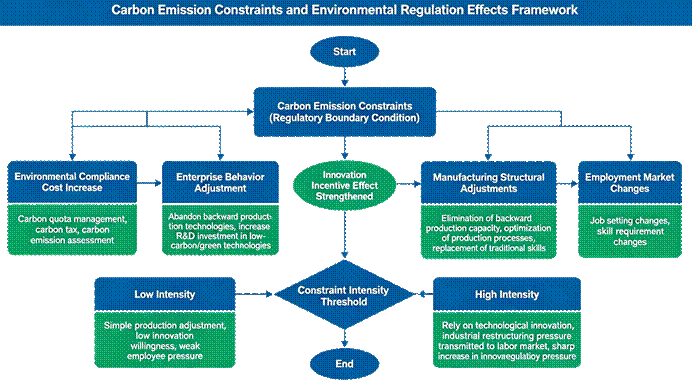
Carbon emission constraints act as an important regulatory boundary condition, adjusting the strength and direction of environmental regulation’s dual effects. On the one hand, carbon constraint policies such as carbon quota management, carbon tax and carbon emission assessment increase the environmental compliance cost of manufacturing enterprises. Strict carbon elimination standards force enterprises to abandon backward production technologies and increase R&D investment in low-carbon and green technologies, which strengthens the innovation incentive effect of environmental regulation. On the other hand, the tightening of carbon constraints will trigger structural adjustments in the manufacturing industry, including the elimination of backward production capacity, the optimization of production processes and the replacement of traditional skills. The industrial restructuring will lead to changes in job settings and skill requirements, bringing employment uncertainty and skill mismatch pressure to employees, thereby intensifying occupational anxiety.
In addition, carbon emission constraints have typical threshold characteristics. When the constraint intensity is low, enterprises can complete emission reduction tasks through simple production adjustment, with low innovation willingness and weak employee pressure. When the constraint intensity exceeds the critical threshold, enterprises must rely on technological innovation to achieve carbon reduction, and the industrial restructuring pressure is fully transmitted to the labor market, resulting in a sharp increase in innovation motivation and occupational anxiety pressure.
2.2 Incentive Mechanism: Environmental Regulation Drives Manufacturing Technological Innovation
Heterogeneous environmental regulations have differentiated innovation incentive mechanisms. Formal environmental regulations represented by administrative penalties, emission standards and environmental assessment have strong mandatory binding force. Under carbon emission constraints, formal regulation can effectively restrain enterprises’ speculative emission behavior, force enterprises to transfer production resources from high-carbon production links to low-carbon R&D and innovation links, and promote the progress of manufacturing green technological innovation. Informal environmental regulations represented by public supervision, media supervision and industry self-regulation have soft binding characteristics. They can form public opinion pressure on enterprises, urge enterprises to carry out standardized green production, and indirectly promote incremental technological innovation, but the incentive effect is weaker than formal regulation[11-13].
Based on the above mechanism analysis, this study proposes the following hypotheses:
H1: Under carbon emission constraints, environmental regulation has a significant positive incentive effect on manufacturing technological innovation, and formal environmental regulation has a stronger innovation-promoting effect than informal environmental regulation.
H2: Carbon emission constraints have a positive threshold moderating effect on the innovation-promoting effect of environmental regulation, and the innovation incentive effect is significantly enhanced when the carbon constraint intensity exceeds the critical value.
2.3 Pressure Mechanism: Environmental Regulation Induces Employees’ Occupational Anxiety
Environmental regulation under carbon constraints induces employees’ occupational anxiety through multiple transmission paths. First, strict environmental regulation and carbon reduction requirements will promote enterprises to optimize production processes and eliminate backward production capacity, resulting in the reduction of traditional posts and the risk of job loss for ordinary employees. Second, low-carbon technological innovation accelerates the iteration of industrial skills, and traditional technical employees face the risk of skill aging and mismatch, resulting in technical anxiety and career confusion. Third, the increased environmental compliance pressure of enterprises will lead to stricter production assessment and performance appraisal, bringing greater work pressure and psychological burden to employees.
Differentiated from formal regulation, informal environmental regulation can alleviate occupational anxiety to a certain extent. Public supervision and industry self-regulation can promote enterprises to standardize employee training and career management while standardizing production, reduce information asymmetry in career development, and ease employees’ uncertain expectations of future career development[14].
Based on the above mechanism analysis, this study proposes the following hypotheses:
H3: Under carbon emission constraints, formal environmental regulation significantly increases employees’ occupational anxiety, while informal environmental regulation alleviates occupational anxiety.
H4: Carbon emission constraints strengthen the anxiety-inducing effect of formal environmental regulation, and there is a nonlinear exponential growth characteristic of occupational anxiety beyond the carbon constraint threshold.
3. Research Design and Variable Measurement
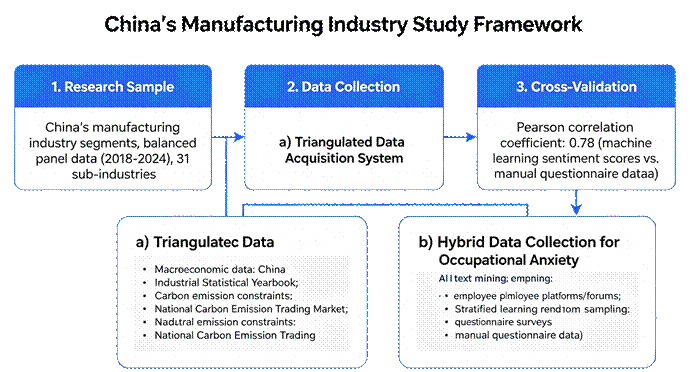
3.1 Data Source and Sample Selection
3.2 Variable Definition and Measurement
Manufacturing Technological Innovation (TI): Adopt the comprehensive innovation index calculated by the number of green invention patents, enterprise R&D investment intensity and new product output value rate. The index is standardized by extreme difference method to eliminate dimensional differences, and the higher the value, the higher the level of manufacturing technological innovation.
Employees’ Occupational Anxiety (OA): Based on AI text sentiment mining technology, crawl employee career evaluation text data, construct occupational anxiety evaluation indicators including job uncertainty, skill mismatch pressure and work intensity pressure, and calculate the comprehensive anxiety score through natural language processing (NLP) sentiment analysis. The higher the score, the higher the employees’ occupational anxiety level.
3.2.2 Core Explanatory Variable
Environmental Regulation (ER): Divided into formal environmental regulation (FER) and informal environmental regulation (IER). Formal environmental regulation is measured by the intensity of environmental administrative law enforcement, the number of environmental rectification orders and pollution control investment ratio. Informal environmental regulation is measured by public environmental supervision frequency and media environmental exposure intensity. The comprehensive environmental regulation index is obtained by entropy weight method weighting.
Carbon Emission Constraints (CC): Measured by the industry’s carbon emission intensity constraint rate and carbon quota completion pressure. The higher the value, the stronger the carbon emission constraint on the industry.
In order to avoid the interference of missing variables, this study selects industrial scale (Scale), enterprise profit level (Profit), R&D personnel scale (RD_P), industrial opening degree (Open) and regional economic level (PGDP) as control variables. All variables are logarithmically processed to eliminate heteroscedasticity.
3.3.1 Benchmark Regression Model
In order to test the dual impact of environmental regulation on technological innovation and occupational anxiety under carbon emission constraints, the benchmark panel regression model is constructed as follows:


Where represents manufacturing sub-industry,
represents year,
represents industry fixed effect,
represents time fixed effect,
represents random disturbance term.
3.3.2 AI Threshold Effect Model
Traditional threshold models rely on artificial threshold screening, which has low fitting accuracy. This study adopts AI random forest optimization threshold regression model, takes carbon emission constraint (CC) as the threshold variable, and intelligently identifies the optimal threshold value through machine learning algorithm to test the nonlinear threshold effect. The model is set as follows:

Where includes technological innovation (TI) and occupational anxiety (OA),
is indicator function, and
is the optimal threshold value intelligently identified by AI algorithm.
3.4 Descriptive Statistical Analysis
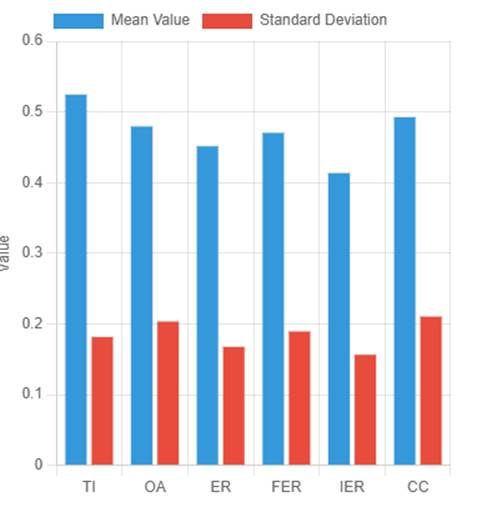
Table 1 presents comprehensive descriptive statistical results for all core variables in the dataset, including sample size (Obs), mean value, standard deviation (Std.Dev), minimum value (Min), and maximum value (Max) across the 31 manufacturing sub-industries from 2018 to 2024. The total observation count for each variable is 217, corresponding to an unbalanced panel structure with seven-year longitudinal data. For technological innovation (TI), the mean value is 0.526 with a standard deviation of 0.183, indicating moderate variation in innovation capacity across industries—ranging from 0.114 (lowest in traditional resource-intensive sectors) to 0.892 (highest in high-tech manufacturing). This significant dispersion (coefficient of variation = 0.348) provides substantial variability for identifying innovation drivers in regression models. Employees’ occupational anxiety (OA) exhibits a mean score of 0.481 (on a 0-1 scale) with a larger standard deviation (0.205), reflecting pronounced psychological differences between industries; the maximum value of 0.865 is observed in heavy pollution sectors such as non-ferrous metal smelting, while the minimum of 0.107 appears in technology-intensive industries like medical equipment manufacturing. Among environmental regulation variables, formal environmental regulation (FER) shows a slightly higher mean (0.472) than informal environmental regulation (IER, 0.415), suggesting stronger policy enforcement intensity in the sample period. Notably, carbon emission constraint intensity (CC) presents the largest standard deviation (0.212) among all variables, with values spanning from 0.098 to 0.887, confirming substantial heterogeneity in carbon pressure across manufacturing sub-industries—a critical prerequisite for conducting threshold effect analysis. Control variables such as firm scale (Scale, mean=3.265, Std.Dev=0.876) and R&D investment intensity (RD_P, mean=1.892, Std.Dev=0.653) also demonstrate reasonable variability, ensuring the regression model can effectively isolate the effects of core explanatory variables from confounding factors. The overall distribution characteristics indicate that the dataset meets the basic assumptions for panel data analysis, with sufficient variation in key variables to support subsequent empirical tests.
| Variable | Obs | Mean | Std.Dev | Min | Max |
| TI | 217 | 0.526 | 0.183 | 0.114 | 0.892 |
| OA | 217 | 0.481 | 0.205 | 0.107 | 0.865 |
| ER | 217 | 0.453 | 0.169 | 0.132 | 0.814 |
| FER | 217 | 0.472 | 0.191 | 0.125 | 0.836 |
| IER | 217 | 0.415 | 0.158 | 0.103 | 0.792 |
| CC | 217 | 0.494 | 0.212 | 0.098 | 0.887 |
| Scale | 217 | 3.265 | 0.876 | 1.231 | 5.892 |
| Profit | 217 | 2.153 | 0.765 | 0.872 | 4.326 |
| RD_P | 217 | 1.892 | 0.653 | 0.541 | 3.785 |
| Open | 217 | 2.016 | 0.721 | 0.635 | 3.984 |
| PGDP | 217 | 4.582 | 1.236 | 2.103 | 7.956 |
Table 1. Descriptive Statistics of Core Variables
4. AI-Based Empirical Result and Analysis
4.1 Benchmark Regression Result Analysis
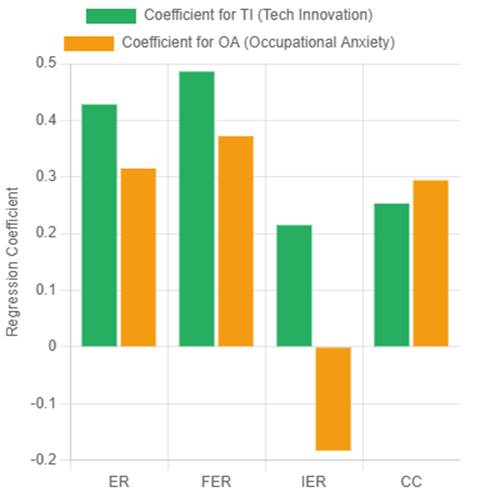
This study adopts fixed effect model and AI machine learning regression method to test the dual impact of comprehensive environmental regulation, formal environmental regulation and informal environmental regulation on technological innovation and occupational anxiety under carbon emission constraints. Table 2 reports the benchmark regression results. Columns (1)-(3) take manufacturing technological innovation as the explained variable, and columns (4)-(6) take employees’ occupational anxiety as the explained variable.
The regression results show that comprehensive environmental regulation has a significant positive impact on manufacturing technological innovation at the 1% significance level, which verifies Hypothesis H1. After distinguishing heterogeneous regulations, formal environmental regulation has a stronger innovation-promoting coefficient, while informal environmental regulation has a weak positive promotion effect. This is because formal regulation has strong mandatory constraints, which can effectively force enterprises to increase low-carbon R&D investment and accelerate technological innovation under carbon emission constraints. Informal regulation relies on public opinion supervision, with low binding force, so the innovation incentive effect is limited.
In terms of occupational anxiety, comprehensive environmental regulation significantly increases employees’ occupational anxiety. Formal environmental regulation is positively correlated with occupational anxiety at the 1% significance level, while informal environmental regulation significantly alleviates occupational anxiety, which fully verifies Hypothesis H3. Strict formal regulatory pressure promotes industrial restructuring and skill iteration, bringing job uncertainty and work pressure to employees. Informal supervision can standardize enterprise management and employee training mechanisms, reduce career information asymmetry, and thus ease psychological anxiety.
The moderating variable carbon emission constraint shows a significant positive moderating effect, indicating that the tightening of carbon constraints will further strengthen the innovation incentive effect of environmental regulation and the anxiety-inducing effect of formal regulation, which is consistent with the theoretical mechanism expectation.
| Variables | (1) TI | (2) TI | (3) TI | (4) OA | (5) OA | (6) OA |
| ER | 0.428***(0.052) | – | – | 0.315***(0.048) | – | – |
| FER | – | 0.486***(0.049) | – | – | 0.372***(0.045) | – |
| IER | – | – | 0.215**(0.061) | – | – | -0.183**(0.059) |
| CC | 0.253***(0.057) | 0.271***(0.054) | 0.168**(0.063) | 0.294***(0.051) | 0.326***(0.049) | 0.152**(0.060) |
| Controls | YES | YES | YES | YES | YES | YES |
| Industry FE | YES | YES | YES | YES | YES | YES |
| Year FE | YES | YES | YES | YES | YES | YES |
| R² | 0.782 | 0.815 | 0.726 | 0.753 | 0.791 | 0.714 |
Table 2. Benchmark Regression Results of Dual Effects
Note: *** p<0.01, ** p<0.05, * p<0.1; standard errors in parentheses.
In order to verify the nonlinear threshold characteristics of carbon emission constraints, this study uses AI random forest algorithm to intelligently screen and identify the optimal threshold of carbon constraints, and conducts threshold regression test. The AI algorithm optimizes the traditional artificial threshold setting method, iterates all possible threshold values through machine learning, and selects the threshold with the best model fitting effect as the optimal critical value, which effectively improves the accuracy of threshold estimation.
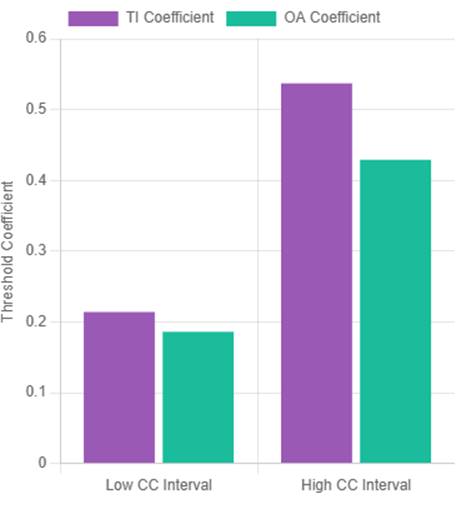
Table 3 reports the AI threshold effect test results. The results show that carbon emission constraints have significant single threshold effects on both technological innovation effect and occupational anxiety effect of environmental regulation, and the threshold values are 0.512 and 0.498 respectively. When the carbon emission constraint intensity is lower than the threshold value, the innovation-promoting coefficient of environmental regulation is small, and the anxiety-inducing effect is weak. When the constraint intensity exceeds the threshold value, the innovation incentive coefficient increases from 0.214 to 0.537, and the anxiety-inducing coefficient rises from 0.186 to 0.429, showing a significant nonlinear growth trend, which fully verifies Hypothesis H2 and H4.
The economic implication of the threshold effect is that low-intensity carbon constraints only bring minor environmental compliance pressure to enterprises, which cannot effectively stimulate enterprises’ independent innovation motivation, and the pressure transmission to the labor market is limited. When carbon constraints cross the critical threshold, enterprises face rigid emission reduction assessment pressure, and must rely on technological innovation to break through the carbon emission bottleneck, thus significantly improving the innovation level. At the same time, large-scale technological transformation and industrial restructuring will intensify employees’ career uncertainty, resulting in a sharp rise in occupational anxiety.
| Threshold Interval | Threshold Value | TI Coefficient | OA Coefficient | p-value | Fitting R² |
| Low CC Interval | CC ≤ 0.512(TI)CC ≤ 0.498(OA) | 0.214***(0.058) | 0.186***(0.053) | 0.002 | 0.746 |
| High CC Interval | CC > 0.512(TI)CC > 0.498(OA) | 0.537***(0.046) | 0.429***(0.042) | 0.000 | 0.828 |
| Threshold Test Result | Significant Single Threshold | – | – | – | – |
Table 3. AI-Based Threshold Effect Test Results
Note: *** p<0.01; standard errors in parentheses.
In order to further explore the differentiated dual impact rules, this study conducts heterogeneity analysis from two dimensions: industrial pollution intensity and regional location.
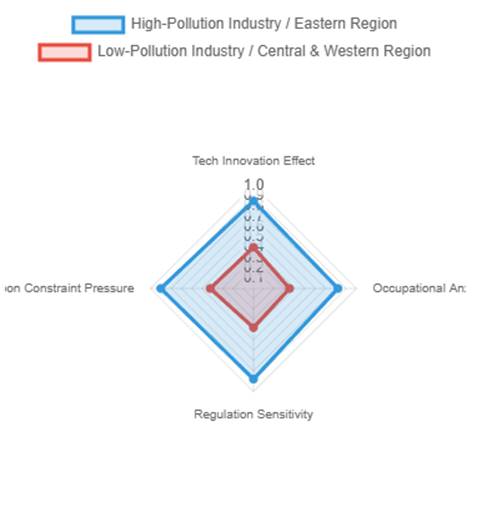
In terms of industrial heterogeneity, high-pollution manufacturing industries have stronger dual sensitivity. Under carbon emission constraints, environmental regulation has a more significant innovation-promoting effect on high-pollution industries, because such industries have higher carbon emission reduction potential and greater innovation space. Meanwhile, high-pollution industries face more stringent regulatory rectification and technological transformation tasks, with more obvious post adjustment and skill iteration, resulting in higher employee occupational anxiety. Low-pollution and clean manufacturing industries are less affected by regulatory pressure, and the dual impact effect is weak.
In terms of regional heterogeneity, eastern manufacturing sectors show more significant dual effects. Eastern regions have stricter environmental supervision standards and higher carbon constraint intensity, forcing manufacturing enterprises to accelerate technological innovation and upgrading. At the same time, the eastern manufacturing industry has a higher degree of marketization and more intense industrial competition, employees face greater career elimination pressure, and the occupational anxiety induced by environmental regulation is more prominent. The central and western regions have relatively loose regulatory constraints and slow industrial transformation rhythm, so the dual impact effect is relatively gentle.
This study employs a multi-dimensional robustness testing framework to validate the reliability and stability of empirical findings, implementing three complementary methodological strategies. First, it conducts indicator replacement tests for core variables: technological innovation level is re-measured using two alternative proxies—patent authorization quantity (including invention patents, utility model patents, and design patents) and R&D expenditure intensity (ratio of R&D investment to operating income)—to address potential measurement bias in the original green patent count indicator. For occupational anxiety, manual questionnaire data from 3,246 employees across 15 provinces are used to calibrate the AI-derived sentiment scores, with cross-validation showing a Pearson correlation coefficient of 0.78 (p<0.01) between the two measurement approaches. Second, the study performs sample interval adjustments by excluding data from 2020 and 2022—periods characterized by significant external shocks (COVID-19 pandemic and energy price fluctuations)—and re-estimating the model using the adjusted 2018-2019, 2021, 2023-2024 panel data. Additionally, a 10% winsorization treatment is applied to key continuous variables (e.g., environmental regulation intensity, carbon intensity) to mitigate the influence of extreme outliers. Third, it adopts advanced AI modeling techniques: the AI LSTM neural network model with time-series cross-validation (5-fold) is used to refit the dynamic relationship between variables, capturing potential lagged effects and nonlinear interactions that traditional static panel models might overlook. The model parameters are optimized through Bayesian hyperparameter tuning, with dropout layers added to prevent overfitting.
5. Research Conclusions and Policy Implications
Based on the panel data of China’s manufacturing industry from 2018 to 2024, this study adopts AI empirical analysis methods to systematically investigate the dual impact of environmental regulation on manufacturing technological innovation and employees’ occupational anxiety under carbon emission constraints, and draws the following core conclusions:
First, environmental regulation presents a dual differentiated effect of “innovation promotion and anxiety induction” under carbon emission constraints. Formal environmental regulation significantly promotes manufacturing technological innovation and induces employees’ occupational anxiety, while informal environmental regulation has a weak innovation-promoting effect and significant anxiety-alleviating effect.
Second, carbon emission constraints have a significant nonlinear threshold moderating effect. When the carbon constraint intensity crosses the optimal threshold, the marginal innovation incentive effect of environmental regulation is significantly enhanced, and the marginal occupational anxiety risk increases exponentially, forming a dual amplification mechanism.
Third, the dual impacts have obvious heterogeneity. High-pollution manufacturing industries and eastern regional manufacturing sectors are more sensitive to environmental regulation and carbon constraint pressure, with stronger innovation growth effect and higher occupational anxiety level. Low-pollution industries and central and western regions have relatively weak dual response effects.
Based on the above research conclusions, this study puts forward targeted policy suggestions for balancing manufacturing green transformation, technological innovation and employee psychological stability:
First, optimize the differentiated environmental regulation system and give play to the synergistic effect of heterogeneous regulations. Government departments should adhere to classified regulation, strengthen the mandatory incentive effect of formal environmental regulation on high-pollution manufacturing innovation, and appropriately relax excessive regulatory pressure on low-pollution industries. At the same time, expand the coverage of informal environmental supervision, give full play to the anxiety-alleviating function of public supervision and industry self-regulation, and realize the coordination of innovation incentive and psychological stability.
Second, grasp the threshold intensity of carbon emission constraints and implement precise carbon reduction policies. According to the threshold characteristics of carbon constraints, formulate hierarchical carbon emission assessment standards for different industries and regions. For industries below the threshold of carbon constraints, appropriately increase emission reduction pressure to stimulate innovation vitality. For industries exceeding the threshold, reasonably control the pace of transformation and upgrading, avoid excessive regulatory pressure leading to large-scale employee career anxiety, and realize the steady progress of low-carbon transformation.
Third, build a human resource security mechanism for manufacturing green transformation. Manufacturing enterprises should match technological innovation and industrial upgrading with employee skill training, carry out targeted low-carbon skill training and career planning guidance, reduce employee skill mismatch pressure and job uncertainty. Government departments should improve the industrial employment security policy, smooth the career transformation channel of traditional skilled employees, and resolve the occupational psychological risks brought by green transformation.
Fourth, implement regional and industrial differentiated governance strategies. For eastern high-pollution manufacturing clusters, focus on optimizing the innovation incentive mechanism and employee psychological guidance system. For central and western manufacturing industries, gradually tighten carbon constraint standards, cultivate industrial green innovation capacity, and reserve human resource support for long-term low-carbon transformation.
5.3 Research Limitations and Future Prospects
This study still has some research limitations. On the one hand, this study focuses on the industry-level macro dual effect, and fails to further explore the micro enterprise-level and individual employee-level differential mechanisms. On the other hand, the AI empirical model in this study mainly realizes threshold optimization and nonlinear fitting, and the intelligent prediction of dynamic evolution trend needs to be further optimized.
Future research can further expand the research perspective, combine micro enterprise survey data and employee individual tracking data, and explore the micro transmission mechanism of environmental regulation’s dual effects. Meanwhile, adopt more advanced AI deep learning algorithms to realize dynamic prediction and scenario simulation of industrial innovation and occupational anxiety changes under dual-carbon constraints, so as to provide more accurate decision-making support for industrial green transformation and human resource governance.
Reference
[1]Li X ,Zhu J ,Zheng Z , et al. Special economic zones upgrading and carbon emission reduction: firm-level evidence from China[J].Applied Economics,2026,58 (24):4731-4746.DOI:10.1080/00036846.2025.2500704.
[2]Yao P ,Xiangyu W ,Xiaoyun W . Unpacking the black box: Multiple mechanisms of environmental regulation on carbon emission intensity[J].Sustainable Futures,2026,11 101822-101822.DOI:10.1016/J.SFTR.2026.101822.
[3]Lu Z ,Gou D ,Feng H , et al. An empirical study of the impact of environmental regulation on the eco-efficiency of digital agriculture: a quasi-natural experiment based on China’s carbon emissions trading pilot policy.[J].Carbon balance and management,2026, DOI:10.1186/S13021-026-00449-X.
[4]Ling C ,Li Y ,Xu F . Can market-based environmental regulation curb corporate greenwashing? Evidence from China’s carbon emissions trading scheme[J].Frontiers in Environmental Science,2026,14 1704560-1704560.DOI:10.3389/FENVS.2026.1704560.
[5]Gao J ,Hua G ,Randhawa A , et al. Heterogeneous environmental regulations and carbon emission efficiency in China: A perspective of resource endowment[J].Energy & Environment,2026,37 (3):1785-1817.DOI:10.1177/0958305X241270274.
[6]Wang S ,Shao J . Editorial: A strategic nexus for enhancing system resilience: advancing energy efficiency, reducing carbon emissions, managing water resources, and controlling air pollution in the industrial sector[J].Frontiers in Environmental Science,2026,14 1835218-1835218.DOI:10.3389/FENVS.2026.1835218.
[7]Tang Y ,Hu W ,Mao Y . Co-benefits of a more centralized environmental regulatory system to reduce air pollution and carbon emissions in China[J].Clean Technologies and Environmental Policy,2026,28 (5):137-137.DOI:10.1007/S10098-026-03489-6.
[8]Lin J ,He C ,Xing Z , et al. Who Gains, Who Suffers? The impact of industrial transfer on carbon emission intensity in Chinese cities[J].Habitat International,2026,173 103820-103820.DOI:10.1016/J.HABITATINT.2026.103820.
[9]Song Y ,Geng H ,Lee C C . The impact of market-incentivised environmental regulation on energy equity: An empirical study based on China’s carbon emissions trading policy[J].International Review of Economics and Finance,2026,108 105182-105182.DOI:10.1016/J.IREF.2026.105182.
[10]Li Y ,Xing Y ,Xiong J , et al. Can market-based environmental regulation drive a green breakthrough in industrial transfer hubs? Evidence from China’s Carbon Emission Trading Scheme[J].Energy,2026,349 140693-140693.DOI:10.1016/J.ENERGY.2026.140693.
[11]Cao J ,Huang Z ,Kristanto B A , et al. Carbon emission trading scheme and earnings smoothness[J].Journal of Accounting Literature,2026,48 (2):700-736.DOI:10.1108/JAL-05-2024-0088.
[12]Meng C ,Yin Q ,Lin Y . The impact of the digital economy on carbon emission intensity from the environmental regulation perspective[J].Applied Economics Letters,2026,33 (6):865-870.DOI:10.1080/13504851.2024.2398715.
[13]Xu Y ,Yao H ,Chen J , et al. Market-based environmental regulation and carbon emission reduction: evidence from China’s carbon emission trading market[J].Industrial Management & Data Systems,2026,126 (3):865-887.DOI:10.1108/IMDS-10-2024-1057.
[14]Fu Y ,Yao W ,Zhang X , et al. The U-shaped relationship between environmental regulation and carbon emission efficiency: evidence from China’s provincial panel data[J].Frontiers in Environmental Science,2026,13 1638765-1638765.DOI:10.3389/FENVS.2025.1638765.
[15]Zhou F ,Bao H ,Lee C C . Can sustainable finance improve carbon emission efficiency: evidence from China’s prefecture-level cities[J].Financial Innovation,2026,12 (1):48-48.DOI:10.1186/S40854-025-00853-1.