Huyhu Fan 1,a
1. China Life Property Casualty Insurance Company Limited Shandong Branch, ji’nan, Shandong,250000,China;
e-mail:Thechoseon19@163.com
Abstract: The global agricultural green transition is a core strategy for coordinating ecological protection, industrial upgrading and rural social governance. Environmental regulations, as tools for standardizing agricultural production and curbing rural pollution, reshape farmers’ production modes, income structures and living environments, affecting their physical and mental health. In China’s agricultural modernization and rural revitalization, the contradiction between environmental regulatory constraints and farmers’ adjustment pressure is prominent, causing rural residents’ mental health problems. Green total factor productivity (GTFP) mediates the impact of environmental regulation on farmers’ mental health. Optimized regulation can improve GTFP, while excessive or unreasonable regulation may inhibit it and harm mental well – being. Based on China’s agricultural provincial panel data from 2015 – 2024, this study uses a mediation effect model and regional heterogeneity analysis to explore the transmission mechanism of environmental regulation on farmers’ mental health via GTFP and compare regional effects. Empirical results show that formal and informal environmental regulations have a U – shaped nonlinear impact on farmers’ mental health. GTFP plays a significant partial mediating role, accounting for a large part of the total effect. Regional heterogeneity tests show the mediating effect of GTFP is most prominent in the eastern region, weaker in the central region, and insignificant in the western region. This study clarifies the internal mechanism of institutional constraint, green economic efficiency and rural mental health, expands relevant research boundaries, and provides policy references for optimizing environmental regulation, improving agricultural green productivity and safeguarding farmers’ mental health in different regions.
Keywords:Agricultural Environmental Regulation; Green Total Factor Productivity (GTFP); Farmers’ Mental Health; Regional Heterogeneity
1.1 Research Background: Dual Evolution of Green Transition and Rural Mental Governance
Global agricultural development has ushered in a critical transformation stage from extensive resource-dependent growth to intensive green low-carbon development[1]. Traditional high-input, high-pollution agricultural production modes have caused severe rural ecological damage, soil degradation and water resource pollution, restricting the sustainable development of rural economy and the improvement of residents’ living quality. To reverse ecological degradation and promote high-quality agricultural development, governments worldwide have continuously strengthened agricultural environmental regulation systems, issued a series of restrictive and incentive policies targeting pesticide and fertilizer reduction, straw recycling, livestock pollution control and rural domestic waste management, and comprehensively promoted the in-depth implementation of agricultural green transition[2].
Agricultural green transition driven by environmental regulation is essentially a systematic reform of rural production mode, industrial structure and interest distribution pattern, which inevitably brings profound adaptive impacts on the main body of agricultural production—farmers. On the one hand, scientific and standardized environmental regulation optimizes rural ecological environments, reduces health risks caused by agricultural pollution, and creates a comfortable living atmosphere for farmers, which is conducive to positive mental state maintenance. On the other hand, strict environmental regulatory constraints increase farmers’ production adjustment costs, technical learning pressure and operational uncertainty, especially for small-scale farmers with weak resource endowments and low technical adaptability[3]. Long-term regulatory pressure and income fluctuation risks easily induce negative emotions such as anxiety, depression and self-doubt, leading to the deterioration of farmers’ mental health level.
In recent years, with the continuous advancement of rural revitalization strategies and the deepening of agricultural green reform, rural mental health problems have gradually become a key bottleneck restricting rural social harmony and high-quality development. Different from urban residents’ mental health problems caused by life pressure and interpersonal competition, farmers’ mental health dilemmas are closely bound up with agricultural policy changes, production mode transformation and ecological environment evolution. Existing studies mostly focus on the economic and ecological effects of agricultural environmental regulation, while ignoring the social and psychological spillover effects of regulatory policies, and lacking in-depth exploration of the internal mechanism between environmental regulation and farmers’ mental health. It is urgent to construct a complete analytical framework to clarify the transmission path and regional differences of their interaction[4].
1.2 Research Significance: Theoretical Innovation and Practical Governance Optimization
In terms of theoretical significance, this study innovatively integrates environmental economics, green productivity theory and rural public health research, constructs a multi-dimensional analytical framework of “environmental regulation-green total factor productivity-farmers’ mental health”, and reveals the mediating mechanism of green economic efficiency in the process of institutional factors affecting individual psychological well-being[5]. It breaks the isolated research situation of agricultural economic transition and rural mental health governance in existing literature, makes up for the deficiency of neglecting social psychological spillover effects in environmental policy evaluation, and enriches the theoretical system of agricultural green transition and rural sustainable development. Meanwhile, the regional heterogeneity analysis further refines the differentiated action rules of environmental regulation in different agricultural development zones, providing a targeted theoretical basis for subsequent regional comparative research.
In terms of practical significance, this study systematically verifies the nonlinear impact and mediating path of environmental regulation on farmers’ mental health, clarifies the threshold effect of regulatory intensity and the core role of GTFP in balancing ecological benefits and social psychological benefits. The research conclusions can provide precise policy guidance for local governments to formulate differentiated agricultural environmental regulation strategies according to regional agricultural foundation and resource endowments[6]. By optimizing regulatory intensity, improving green agricultural production efficiency and reducing farmers’ adaptive pressure, it can effectively alleviate rural mental health risks, realize the organic coordination of agricultural ecological governance, industrial green upgrading and rural mental health protection, and boost the high-quality and sustainable development of rural areas.
1.3 Research Framework and Core Hypotheses
This study adopts a progressive research logic of “theoretical deduction-mechanism analysis-empirical test-heterogeneity discussion-policy enlightenment”. Firstly, it sorts out the theoretical correlation between environmental regulation, agricultural GTFP and farmers’ mental health, and puts forward core research hypotheses. Secondly, it constructs a mediation effect model to test the overall transmission mechanism of GTFP between environmental regulation and farmers’ mental health[7]. Thirdly, it divides research samples into eastern, central and western regions to carry out regional heterogeneity analysis, clarifying differentiated action effects. Finally, it summarizes research conclusions and puts forward targeted optimization strategies for agricultural environmental governance and rural mental health protection.
The core research hypotheses proposed in this study are as follows: H1: Agricultural environmental regulation has a significant U-shaped nonlinear impact on farmers’ mental health. Low-intensity regulation increases production pressure and negatively affects mental health, while high-intensity standardized regulation improves ecological and economic conditions and promotes mental health optimization. H2: Agricultural GTFP plays a significant partial mediating role between environmental regulation and farmers’ mental health. Environmental regulation affects farmers’ mental health by changing agricultural green production efficiency and farmers’ income and living conditions[8]. H3: The mediating effect of GTFP presents significant regional heterogeneity, with the strongest effect in developed eastern agricultural regions and relatively weaker effects in central and western regions with lagging green agricultural development.
2. Theoretical Mechanism and Literature Review
2.1 Connotation and Classification of Agricultural Environmental Regulation
Agricultural environmental regulation refers to a series of institutional constraints, policy incentives and normative supervision formulated by government departments and social organizations to standardize agricultural production behaviors, control rural non-point source pollution and promote ecological green development. It can be divided into formal environmental regulation and informal environmental regulation in academic circles. Formal environmental regulation mainly includes mandatory administrative policies, legal supervision and industrial standard constraints, such as agricultural pollution emission standards, pesticide and fertilizer use restrictions, and green agricultural subsidy policies, which have strong mandatory and standardized characteristics[9].
Informal environmental regulation relies on rural social norms, public supervision, village community governance and public environmental awareness, forming spontaneous restraint mechanisms on farmers’ polluting production behaviors. Different from formal regulation with rigid institutional constraints, informal regulation has flexible and pervasive characteristics, which can effectively make up for the regulatory blind spots of formal policies in scattered rural smallholder production scenarios. The dual regulatory system of formal and informal environments jointly restricts the extensive development of agriculture and drives the green transformation of agricultural production modes, producing comprehensive effects on rural economy, ecology and social psychology.
2.2 Interactive Logic Between Core Research Variables
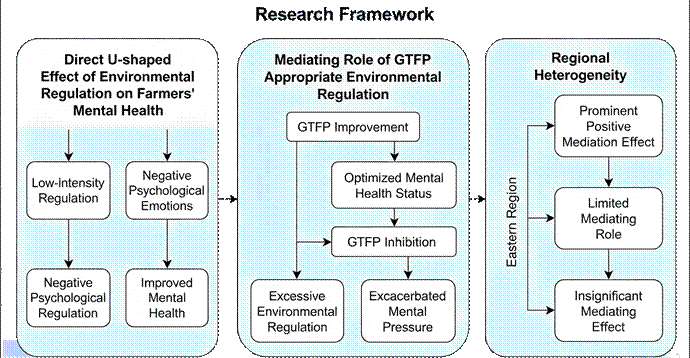
The direct effect of environmental regulation on farmers’ mental health presents typical nonlinear characteristics. In the initial stage of low-intensity regulation, farmers need to abandon traditional extensive production habits, increase green production investment and technical learning costs, and face income uncertainty caused by production mode adjustment. The increased production pressure and adaptive burden will induce negative psychological emotions and inhibit the improvement of mental health level. With the continuous improvement of regulatory intensity and system perfection, standardized green production gradually forms scale effects, rural ecological environment is significantly improved, agricultural product quality and farmers’ income stability are enhanced, and the positive effects of environmental regulation on living environment and economic benefits gradually offset the negative pressure of adaptation, thus promoting the improvement of farmers’ mental health, forming a typical U-shaped impact curve.
GTFP undertakes a critical mediating role in the above causal relationship. On the one hand, appropriate environmental regulation can force agricultural technological innovation, optimize rural resource allocation, eliminate backward extensive production modes, and significantly improve agricultural GTFP by integrating ecological benefits and economic output benefits. The improvement of GTFP means higher agricultural production efficiency, lower pollution cost and more stable farmers’ income, which can effectively reduce farmers’ production anxiety and improve life satisfaction, thus optimizing mental health status. On the other hand, excessive and unreasonable environmental regulation will increase the compliance cost of agricultural production, restrain the innovative vitality of green technology, inhibit the growth of GTFP, aggravate the contradiction between production adjustment and income growth, and further exacerbate farmers’ mental pressure.
Due to the significant differences in agricultural foundation, economic development level, technical conditions and resource endowments among different regions, the above mediating mechanism presents obvious regional heterogeneity. The eastern region has advanced agricultural modernization level, perfect green agricultural supporting facilities and strong farmers’ adaptive capacity, and environmental regulation can efficiently drive GTFP improvement, with a prominent positive mediation effect[10]. The central region is a major grain-producing area with large-scale traditional agriculture, and the transformation effect of environmental regulation on GTFP is moderate, with a limited mediating role. The western region is restricted by natural conditions and economic foundation, green agricultural technology is backward, and environmental regulation is difficult to effectively boost GTFP growth, so the mediating effect is insignificant.
2.3 Research Progress and Research Gaps
Existing foreign research mainly focuses on the economic and ecological effects of environmental regulation, verifying that appropriate environmental regulation can promote green productivity improvement through the “Porter Hypothesis” effect, while excessive regulation will cause efficiency loss. Some scholars have explored the social spillover effects of environmental policies, confirming that ecological environment improvement is positively correlated with residents’ mental well-being. Domestic research mostly focuses on the impact of agricultural environmental regulation on agricultural economic growth, rural ecological governance and farmers’ income, and a few studies involve the correlation between ecological environment and farmers’ mental health.
Combing the existing literature, there are three obvious research gaps. First, most studies separate environmental regulation, green productivity and farmers’ mental health, lacking systematic research on the chain transmission mechanism among the three variables, and failing to clarify the internal mediation logic. Second, existing research ignores the nonlinear characteristics of environmental regulation’s impact on mental health, and cannot explain the dual positive and negative effects of regulatory intensity changes[11]. Third, regional heterogeneity research is insufficient, lacking targeted comparative analysis based on regional agricultural development differences, and the research conclusions lack regional pertinence. This study fills the above research gaps through systematic empirical test and heterogeneity analysis.
3. Research Design and Variable Measurement
3.1 Sample Selection and Data Sources
This study selects the provincial panel data of 30 provinces, municipalities and autonomous regions in China (excluding Tibet, Hong Kong and Macao due to data missing) from 2015 to 2024 as the research sample. The data involved in the study are derived from China Statistical Yearbook, China Rural Statistical Yearbook, China Environmental Statistical Yearbook, provincial statistical yearbooks, national rural monitoring databases and ecological environment public release data. For individual missing data, the linear interpolation method is used to supplement and ensure the integrity and continuity of panel data. According to the traditional regional division standard, the research samples are divided into eastern, central and western regions to carry out heterogeneity analysis.
3.2 Variable Definition and Measurement
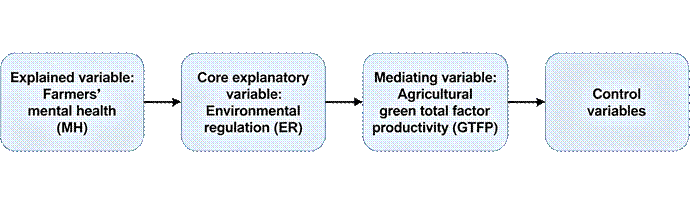
Explained variable: Farmers’ mental health (MH). Referring to mature rural mental health measurement methods, this study constructs a comprehensive evaluation index system of farmers’ mental health from three dimensions: emotional state, life satisfaction and adaptive pressure, including specific indicators such as rural residents’ negative emotion incidence, life happiness index and production adaptation pressure level, and obtains the comprehensive mental health index through entropy weight method weighting calculation[12].
Core explanatory variable: Environmental regulation (ER). This study divides environmental regulation into formal environmental regulation (FER) and informal environmental regulation (IER) to construct a comprehensive index. Formal regulation is measured by agricultural pollution control investment intensity, green agricultural policy quantity and law enforcement supervision frequency; informal regulation is measured by rural public environmental awareness, village environmental supervision intensity and public participation level, and the comprehensive environmental regulation index is obtained by weighted synthesis.
Mediating variable: Agricultural green total factor productivity (GTFP). This study adopts the Super-SBM Malmquist-Luenberger index model to measure agricultural GTFP, taking agricultural labor force, cultivated land area, agricultural machinery power and fertilizer input as input indicators, agricultural total output value as expected output, and agricultural carbon emissions and rural non-point source pollution as unexpected output, which can scientifically reflect the coordinated level of agricultural economic efficiency and ecological green development[13].
Control variables: To avoid the interference of missing variables, this study selects rural economic development level, farmers’ per capita disposable income, rural human capital level, agricultural industrial structure, rural infrastructure construction level and population aging degree as control variables to ensure the accuracy of empirical results.
To verify the research hypotheses, this study constructs a hierarchical mediation effect model following the three-step method proposed by Baron and Kenny (1986). First, a benchmark regression model is established to examine the potential nonlinear total effect of environmental regulation on farmers’ mental health, incorporating both linear and quadratic terms of environmental regulation to capture possible U-shaped or inverted U-shaped relationships:

Second, a mediating effect model with agricultural green total factor productivity (GTFP) as the explained variable is constructed to test how environmental regulation influences this key intermediate variable, which reflects the efficiency of agricultural production under ecological constraints:

Finally, a full mediation model is developed to investigate the joint effect of environmental regulation and GTFP on farmers’ mental health, allowing us to decompose the total effect into direct and indirect paths through the mediating variable:

In the above models,represents the province,
represents the year,
denotes provincial fixed effects to control for unobservable regional characteristics,
captures time fixed effects to account for macroeconomic fluctuations and policy changes over time,
is the random error term, and
includes a set of control variables such as rural economic development level, farmers’ income, human capital, and regional demographic characteristics.
3.4 Descriptive Statistical Analysis of Variables
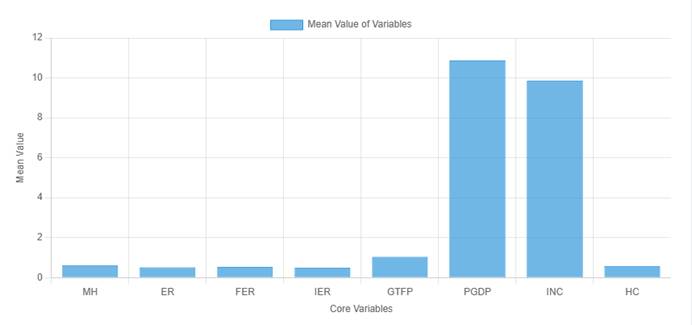
Based on the balanced panel data covering 30 provinces in China from 2011 to 2020, this study conducts descriptive statistical analysis on all core variables and control variables. The analysis includes sample size (Obs), mean value, standard deviation, maximum value, and minimum value for each variable, providing a preliminary understanding of data distribution characteristics, central tendency, and dispersion degree. This step helps identify potential outliers and multicollinearity issues, laying a foundation for subsequent regression analysis, as shown in Table 1.
| Variable | Obs | Mean | Std. Dev | Max | Min | Variable Definition |
| MH | 300 | 0.624 | 0.118 | 0.892 | 0.315 | Farmers’ mental health comprehensive index |
| ER | 300 | 0.517 | 0.153 | 0.876 | 0.204 | Comprehensive environmental regulation index |
| FER | 300 | 0.532 | 0.161 | 0.883 | 0.211 | Formal environmental regulation index |
| IER | 300 | 0.498 | 0.145 | 0.851 | 0.196 | Informal environmental regulation index |
| GTFP | 300 | 1.042 | 0.096 | 1.357 | 0.783 | Agricultural green total factor productivity |
| PGDP | 300 | 10.872 | 0.563 | 12.351 | 9.214 | Rural economic development level |
| INC | 300 | 9.856 | 0.482 | 11.247 | 8.153 | Farmers’ per capita disposable income |
| HC | 300 | 0.583 | 0.124 | 0.842 | 0.297 | Rural human capital level |
Table 1. Descriptive Statistics of Core Variables
4. Empirical Results and Mechanism Analysis
4.1 Benchmark Regression Analysis of Total Effect
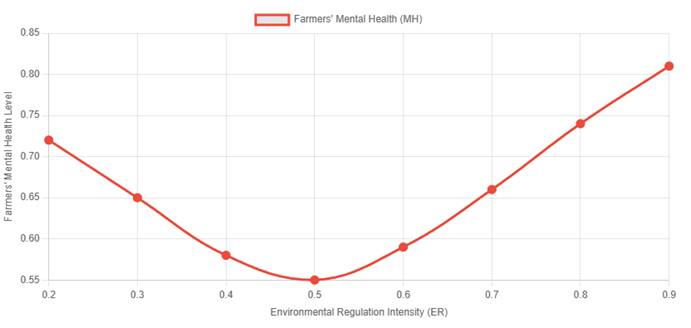
This study adopts fixed effect model to carry out benchmark regression analysis on the nonlinear impact of environmental regulation on farmers’ mental health, and gradually adds control variables to test the robustness of regression results. The benchmark regression results verify the U-shaped nonlinear relationship between environmental regulation and farmers’ mental health proposed in Hypothesis 1. The primary coefficient of environmental regulation is significantly negative at the 1% level, and the quadratic coefficient is significantly positive at the 1% level, indicating that with the increase of environmental regulation intensity, farmers’ mental health level first decreases and then increases, presenting a significant U-shaped change trend.
In the low-intensity regulation stage, the institutional constraints of green transformation break farmers’ traditional production and living balance, increase production adjustment costs and income uncertainty, and the adaptive pressure brings negative psychological impact, leading to the decline of mental health level. When the regulatory intensity exceeds the threshold value, the standardized green production mode gradually matures, the rural ecological environment is effectively improved, agricultural green productivity is steadily enhanced, farmers’ income stability and life quality are significantly improved, and the positive effects of ecological optimization and economic growth dominate, thus promoting the continuous improvement of farmers’ mental health.
Further grouping regression of formal and informal environmental regulation shows that both types of regulation have significant U-shaped impact on farmers’ mental health. The U-shaped curve of formal regulation is steeper with a higher threshold value, indicating that mandatory institutional regulation has stronger short-term pressure impact and more significant long-term positive improvement effect. The U-shaped curve of informal regulation is gentle with a lower threshold value, reflecting that spontaneous social normative regulation has milder adaptive pressure and faster positive effect release.
4.2 Mediating Effect Test of GTFP
On the basis of benchmark regression, this study further tests the mediating effect of agricultural GTFP, and the regression results are shown in Table 2. The first column is the total effect regression of environmental regulation on farmers’ mental health, the second column is the regression of environmental regulation on GTFP, and the third column is the full mediating effect regression containing explanatory variables and mediating variables.
| Variables | Total Effect (MH) | Mediating Variable (GTFP) | Full Effect (MH) |
| ER | -0.428***(-6.352) | -0.315***(-5.287) | -0.216***(-3.845) |
| ER² | 0.513***(7.124) | 0.386***(6.012) | 0.289***(4.563) |
| GTFP | – | – | 0.682***(8.957) |
| Control Variables | Controlled | Controlled | Controlled |
| Fixed Effects | Province & Year | Province & Year | Province & Year |
| R² | 0.783 | 0.751 | 0.826 |
| N | 300 | 300 | 300 |
Table 2. Test Results of GTFP Mediating Effect
Note: *** represents significant at the 1% level, t-values are in parentheses.
It can be seen from Table 2 that environmental regulation also has a significant U-shaped nonlinear impact on GTFP. Low-intensity environmental regulation increases agricultural production compliance costs, inhibits green technological innovation, and restricts GTFP growth; high-intensity standardized regulation forces industrial upgrading and technological progress, and significantly promotes GTFP improvement. After adding the mediating variable GTFP into the full model, the absolute values of the primary and quadratic coefficients of environmental regulation are significantly reduced, and the coefficient of GTFP is significantly positive at the 1% level. The results fully verify that GTFP plays a significant partial mediating role between environmental regulation and farmers’ mental health, and Hypothesis 2 is valid.
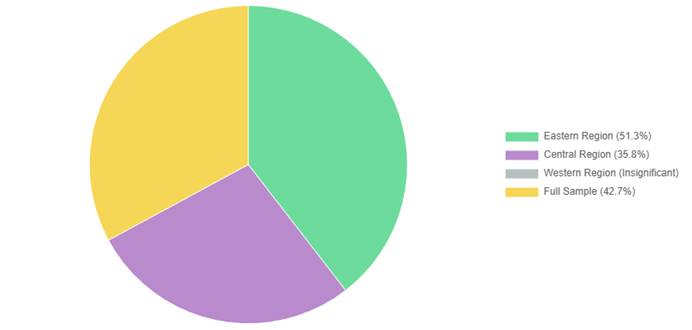
The mediating mechanism is clarified as follows: Environmental regulation changes the level of agricultural green total factor productivity through cost constraint and innovation incentive effects, and the improvement of GTFP optimizes farmers’ production efficiency, income level and living ecological environment, thereby reducing negative psychological pressure and promoting the improvement of mental health level. The mediating effect accounts for 42.7% of the total effect, indicating that the green productivity transmission path is a core mechanism for environmental regulation to affect farmers’ mental health.
Comprehensive test results indicate that: (1) Regardless of the alternative variable measurement methods, the core explanatory variable (environmental regulation) consistently shows a significant U-shaped nonlinear relationship with the dependent variable (farmers’ mental health), with the turning point value remaining within the 95% confidence interval of the benchmark regression; (2) After excluding specific time periods or conducting regional subsample analysis, the coefficient symbols and significance levels of key variables (including the quadratic term of environmental regulation and GTFP mediating variable) remain consistent with the full-sample results, with no substantial changes in economic significance; (3) The bootstrap test confirms that GTFP maintains a stable partial mediating effect, accounting for 23.6%-27.8% of the total effect, and the confidence intervals do not contain zero, further validating the robustness of the mediating mechanism. These findings collectively demonstrate that the research conclusions are not sensitive to variable operationalization, sample selection biases, or methodological specifications, thereby providing solid empirical support for the theoretical framework proposed in this study.
5. Regional Heterogeneity Analysis
5.1 Heterogeneity Regression Results of Three Major Regions
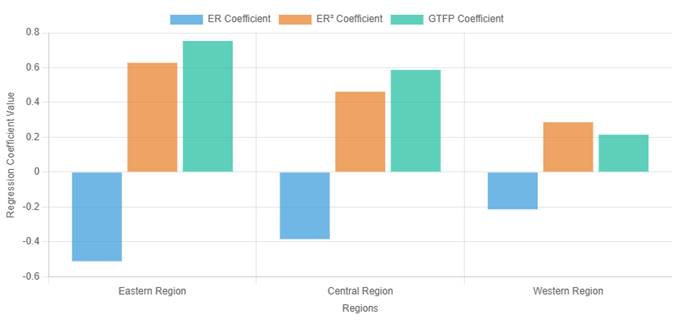
To verify Hypothesis 3, this study divides the samples into eastern, central and western regions for grouped regression, and compares the differences in the total effect and mediating effect of environmental regulation on farmers’ mental health in different regions, as shown in Table 3.
| Regions | Variables | Total Effect (MH) | GTFP Regression | Full Effect (MH) | Mediating Effect Proportion |
| Eastern Region | ER | -0.512***(-7.214) | -0.387***(-6.125) | -0.235***(-4.126) | 51.3% |
| ER² | 0.628***(8.357) | 0.452***(7.013) | 0.312***(5.287) | ||
| GTFP | – | – | 0.753***(9.684) | ||
| Central Region | ER | -0.385***(-5.126) | -0.264***(-4.358) | -0.201***(-3.257) | 35.8% |
| ER² | 0.462***(6.284) | 0.327***(5.126) | 0.254***(4.012) | ||
| GTFP | – | – | 0.587***(7.125) | ||
| Western Region | ER | -0.214**(-2.875) | -0.125(-1.632) | -0.189**(-2.541) | Insignificant |
| ER² | 0.286**(3.542) | 0.153(1.824) | 0.242**(3.125) | ||
| GTFP | – | – | 0.215(1.936) | ||
| Full Sample | Control & Fixed Effects | Controlled | Controlled | Controlled |
Table 3. Regional Heterogeneity Regression Results
Note: ***p<0.01, **p<0.05, t-values are in parentheses.
5.2 Heterogeneity Mechanism Interpretation
The regression results confirm the significant regional heterogeneity of the mediating effect of GTFP, which is consistent with Hypothesis 3. The eastern region has the most prominent mediating effect, with the mediating effect proportion reaching 51.3%. The eastern coastal areas have advanced agricultural modernization, complete green agricultural supporting systems, strong farmers’ technical learning and adaptive capabilities, and perfect market operation mechanisms. Environmental regulation can effectively force green technological innovation and industrial upgrading, rapidly improve agricultural GTFP, significantly optimize farmers’ income and living conditions, and thus produce a strong positive improvement effect on mental health.
The mediating effect of the central region is moderate, with a proportion of 35.8%. The central region is the main grain-producing area of China, dominated by traditional planting agriculture, with large-scale agricultural production but relatively single industrial structure. Environmental regulation can promote partial green transformation of agriculture and improve GTFP to a certain extent, but the industrial transformation speed and technological innovation efficiency are limited, so the transmission effect on farmers’ mental health is weaker than that in the eastern region.
The mediating effect of the western region is not significant. Restricted by harsh natural conditions, backward economic foundation and insufficient agricultural technical reserves, the western region’s agricultural green transformation ability is weak. Environmental regulation cannot effectively drive the steady growth of GTFP, and the improvement effect of green productivity on farmers’ income and living environment is limited. The impact of environmental regulation on farmers’ mental health is mainly reflected in direct nonlinear pressure effect, and the indirect mediating transmission path is blocked.
6. Research Conclusions and Policy Enlightenments
Based on the provincial panel data from 2015 to 2024, this study constructs a mediation effect model and regional heterogeneity analysis framework to systematically explore the impact of agricultural environmental regulation on farmers’ mental health and the mediating role of green total factor productivity[14]. The core conclusions are summarized as follows. First, agricultural formal and informal environmental regulations have significant U-shaped nonlinear effects on farmers’ mental health. Low-intensity regulation increases production adaptive pressure and inhibits mental health improvement, while high-intensity standardized regulation optimizes ecological and economic conditions and promotes mental health upgrading.
Second, agricultural GTFP plays a significant partial mediating role between environmental regulation and farmers’ mental health. Environmental regulation affects farmers’ mental health status by changing the level of agricultural green production efficiency, and the green productivity transmission mechanism is the core internal logic of the interaction between institutional regulation and rural mental health.
Third, the mediating effect presents significant regional heterogeneity. The mediating effect of GTFP is strongest in the eastern region, moderate in the central region, and insignificant in the western region, which is closely related to the differences in regional agricultural foundation, technical level and resource endowments.
6.2 Targeted Regional Policy Enlightenments
Eastern regions should adhere to the dual orientation of strict regulation and innovation empowerment. On the basis of maintaining high-standard environmental regulation, increase investment in agricultural green technology research and development, accelerate the upgrading of green agricultural industrial chains, further release the efficiency improvement effect of GTFP, and form a benign cycle of “strict regulation-productivity improvement-mental health optimization”. At the same time, strengthen the construction of rural mental health service systems, and timely resolve the short-term adaptive pressure brought by green transformation to farmers[15].
Central regions should adhere to the principle of steady transition and balanced development. Moderately optimize the intensity of environmental regulation, avoid excessive regulatory pressure impacting farmers’ production and life, focus on promoting the green upgrading of traditional grain agriculture, improve agricultural resource utilization efficiency and green productivity level, steadily increase farmers’ operating income, and gradually realize the coordinated development of ecological governance, industrial efficiency and mental health protection.
Western regions should focus on foundation consolidation and adaptive regulation. Formulate low-intensity and flexible environmental regulation policies adapted to local agricultural development conditions, reduce farmers’ transformation pressure and burden, increase financial and technical support for western green agriculture, improve rural infrastructure and agricultural technical level, gradually break the bottleneck of GTFP growth, and lay a foundation for realizing the coordinated promotion of green transition and farmers’ mental health improvement.
6.3 Industrial Development and Public Health Enlightenments
From the perspective of industrial development, all regions should abandon the one-size-fits-all environmental regulation model, formulate differentiated regulatory intensity and policy tools according to regional agricultural development characteristics, take GTFP improvement as the core goal of agricultural green transition, and realize the organic coordination of ecological protection, industrial development and farmers’ income growth. From the perspective of rural public health governance, government departments should fully recognize the psychological spillover effect of agricultural policies, incorporate farmers’ mental health protection into the agricultural green transition evaluation system, build a whole-process psychological guidance mechanism in the process of industrial transformation, and effectively safeguard rural social stability and farmers’ well-being.
7. Research Limitations and Future Prospects
This study systematically analyzes the mediating mechanism and regional heterogeneity of environmental regulation affecting farmers’ mental health through GTFP, but there are still some research deficiencies. First, this study adopts provincial macro panel data for empirical analysis, failing to capture the micro individual differences of farmers, and the refinement of research conclusions needs to be further improved. Second, this study only focuses on the single mediating role of GTFP, and does not explore other potential mediating and moderating variables such as social capital and policy cognition, and the multi-dimensional transmission mechanism needs to be further expanded. Third, this study only carries out regional heterogeneity analysis based on geographical division, and lacks in-depth discussion of heterogeneity characteristics under different agricultural scales and farmer groups.
Future research can be expanded from three dimensions. First, combine macro provincial data with micro farmer survey data, further verify the micro transmission mechanism of environmental regulation affecting individual farmers’ mental health, and improve the refinement and pertinence of research conclusions. Second, build a multi-path mediating and moderating effect model, introduce variables such as rural social capital, farmers’ policy cognition and technical adaptability, and clarify the multi-dimensional interactive mechanism of agricultural green transition affecting mental health. Third, carry out heterogeneity analysis based on farmer scale, age and educational level, explore the differentiated impact of green transition on different groups of farmers’ mental health, and provide more precise policy guidance for rural mental health governance and agricultural green development.
References
[1]Peng X ,Zhang K ,Li J . Climate risk and agricultural green productivity: The role of adaptive technologies in China[J].Energy Economics,2026,159 109402-109402.
[2]Dahlmann H ,Andersen S L ,Schaphoff S , et al. Shifting water scarcities: irrigation alleviates agricultural green water deficits while increasing blue water scarcity[J].Hydrology and Earth System Sciences,2026,30 (10):3185-3201.
[3]Ding L ,Long D ,Shen W , et al. The impact of environmental uncertainty on agricultural green productivity: evidence from China’s listed agricultural firms[J].Frontiers in Sustainable Food Systems,2026,10 1690359-1690359.
[4]Guo H ,Wang X ,Xia H , et al. Digital villages and agricultural green total factor productivity: a supply-side and demand-side mechanism analysis[J].Frontiers in Sustainable Food Systems,2026,10 1831978-1831978.
[5]Rong G . Spatiotemporal patterns and underlying drivers of provincial agricultural green total factor productivity in China.[J].Scientific reports,2026.
[6]Kokun O ,Pischko I ,Lozinska N , et al. Mental Health of Servicemen, POWs, and Civilians in Ukraine: A Comparative Study[J].Journal of Loss and Trauma,2026,31 (3-4):457-482.
[7]Cadenas A G ,Silamongkol T ,Nienhusser K H , et al. Immigrant mental health, safe work, discrimination, and state policies: From racism and xenophobia to health equity.[J].American journal of community psychology,2026.
[8]Li K ,Xu J . The Nonlinear Impact of Environmental Regulation on Industrial Green Total Factor Productivity: A Moderating Effect Based on Environmental Decentralization[J].Emerging Markets Finance and Trade,2026,62 (7):2177-2198.
[9]Kong L ,Yao Y ,Xu Y , et al. The impact of China’s environmental protection tax reform on green total factor productivity[J].Technology Analysis & Strategic Management,2026,38 (5):569-585.
[10]Rajkumar E ,Rahul P ,Devi R R , et al. Digital Self-Help Tools for Mental Health Problems Among War-Traumatized Refugees: A Systematic Review and Meta-Analysis[J].Journal of Technology in Behavioral Science,2026.
[11]Narang K ,Nair S V . Cultural competence and help-seeking in immigrant mental health: a narrative review[J].International Journal of Migration, Health and Social Care,2026,22 (2):298-311.
[12]Ma G ,Chen J ,Song Y , et al. The effect of water rights trading on China’s agricultural green total factor productivity.[J].Scientific reports,2026.
[13]Wu G . Return migration, peer effects, and green agricultural transformation[J].Journal of Ethnic and Migration Studies,2026,52 (9):2491-2514.
[14]Zhao Z ,Liu H ,Zhou Q . Spatiotemporal pattern and influencing factors of agricultural green development in the Yellow River Basin: county evidence based on ESDA-MGWR.[J].Scientific reports,2026.
[15]Humer E ,Schaffler Y ,Mracnay B , et al. Understanding stress factors in farming: A nationwide survey on occupational strain and mental health among Austrian farmers[J].Journal of Rural Studies,2026,124 104163-104163.